
Brussels Pride week comes with its usual share of parties and parades, but this year it also brings a quieter, more unsettling question: who do we become when our faces disappear? With Faceless, Brussels‑based painter and filmmaker Pablo Diartinez turns the scroll culture of bodies, DMs and avatars into a series of oil portraits that look straight at our ways of showing – and hiding – ourselves.
The exhibition opens on Thursday 14 May 2026 at 19:45 at Cinema Galeries and runs daily from 12:00 to 21:00 until 28 June 2026, with free admission. Set in the heart of the Galerie de la Reine, as part of Panorama: Cinéma Ibérique 2026, Faceless feels like a perfectly placed mirror for a Pride season built on visibility, ambiguity and desire.
Two series, one question: what do we show, what do we hide?
Faceless brings together two distinct series of faceless oil portraits: FacelessD and FacelessD.M. Both revolve around bodies and images without faces, but they occupy opposite ends of the spectrum.
In FacelessD – the “D” stands for desire – Diartinez taps into the flood of viral self‑portraits posted by strangers online: mostly men, mostly posing, bodies on display while faces are strategically cropped out or hidden. Painted on unfolded tea bag paper, these figures become both fragile and over‑determined: delicate surfaces carrying a globalised iconography of male homoerotic desire. A sneaker, a backpack, a hand, a fold of skin – each painting breaks the body down into recurring attributes, the visual clichés through which masculinity is eroticised and standardised.
FacelessD.M (for direct message) shifts into a more intimate, unsettling register. Here, the artist works from real exchanges with people in his life: friends, family, flatmates, partners, occasional encounters. Each piece is a small wooden box built as a diptych. On the outside, a single eye stands in for the contact’s avatar; on the inside, a tiny oil portrait painted from a self‑image that person shared, paired with a fragment of one of their messages. Births and deaths, illness and joy, stupid jokes and confessions – they all end up sharing the same cramped space.
Visitors can choose which boxes to open. For a moment, you become a reader, a voyeur, a confidant. The gesture is simple – lifting a lid – but it echoes something we do all day: tapping open conversations, entering other people’s intimacies, then closing them again.
From viral thirst traps to private DMs
What makes Faceless particularly sharp for a queer audience is the way it connects the public and private sides of desire. On one wall, you have bodies that flood blogs and social media, anonymous and interchangeable, faces erased but bodies hyper‑visible. On another, you have the same logic of self‑exposure, but in the enclosed space of messaging apps, where a shared selfie becomes part of a thread that moves between small talk and vulnerability.
By painting these images, Diartinez slows them down. The viral speed of screenshots and swipes is replaced by the time of brushstrokes and drying oil. The works ask: how much of our identity is built in these exchanges? What remains of us when the face is removed, when only an eye, a shoe or a sentence stands in?
For anyone who has ever sent a risky picture, stared too long at a torso with no head, or felt both exposed and invisible online, Faceless will feel uncomfortably familiar.
Pride week, Iberian cinema and a Spanish‑Belgian gaze
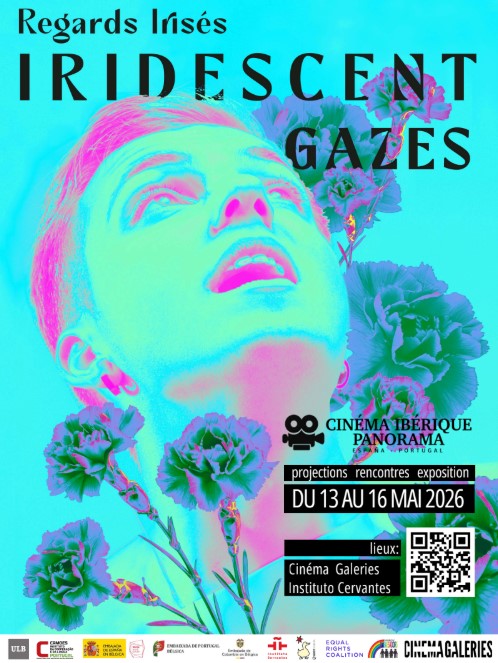
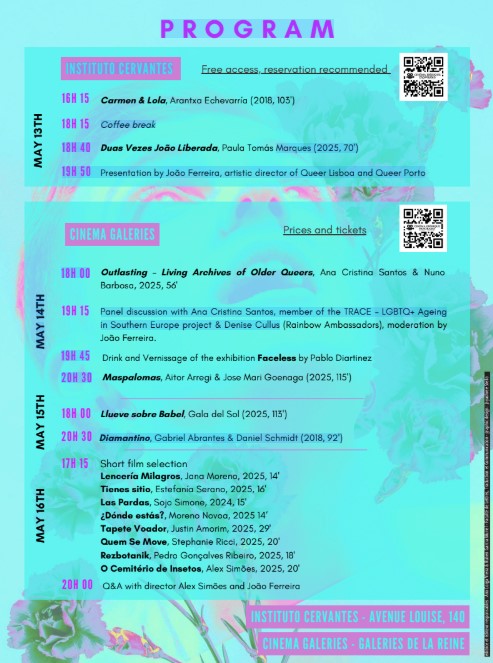
Faceless opens right in the middle of Brussels Pride Week, when the city is already buzzing with rainbow flags, marches and queer nightlife. While the streets outside fill with bodies claiming visibility, the exhibition offers a quieter, more introspective angle on what it means to be seen – and on how queer desire circulates far beyond physical spaces.
The show is presented within Panorama: Cinéma Ibérique 2026, a Spanish and Portuguese film focus hosted by Cinema Galeries. It is organised by Cinema Galeries and supported by the Embassy of Spain in Belgium and SPAIN arts & culture, connecting Diartinez’s work to a broader conversation about contemporary Iberian creation and its echoes in Brussels.
It’s a reminder that Pride in the capital is not only about parades and parties; it also lives in exhibition halls, cinema screens and the small, oil‑painted boxes where other people’s messages quietly wait to be opened.
Practical info
Presented by: Cinema Galeries, Embassy of Spain in Belgium, SPAIN arts & culture
Exhibition: Faceless – Pablo Diartinez
Where: Cinema Galeries, Galerie de la Reine 26, 1000 Brussels
Vernissage: Thursday 14 May 2026, 19:45
Dates: 14 May → 28 June 2026
Opening hours: Daily, 12:00 → 21:00
Admission: Free
Within: Panorama: Cinéma Ibérique 2026
KET Magazine is a community‑driven, non‑profit magazine run by volunteers based in Brussels. Get in touch to share your thoughts or tell us about your activities. You can also promote your events on our website or support our work with a donation. Contact us at Info@ket.brussels.
You may also like
-

Lou Trotignon brings transition, testosterone and a little fish energy to Brussels
What if the person everyone expected you to be simply wasn’t you? In Mérou, comedian
-

Love behind the lines: Lukas Dhont’s Coward comes to Flagey
In Coward, a young soldier looking to prove himself finds something he did not expect
-

Meet Benka: the Brussels pop artist who caught our ear at Tels Quels
KET loved discovering Benka at the Tels Quels Talent Show at Les Grands Carmes on
-
Africa Legacy: a different way to look at art history in Brussels
More than 250 works, 22 countries and a conversation across centuries: Africa Legacy – Berceau
-

Adam La Nuit: Making Music Between Worlds
For Adam La Nuit, belonging doesn’t mean choosing one world over another. The Belgian-Congolese artist