
For the first time in its history, Ukraine’s Supreme Court has recognised a same-sex couple as a “de facto family”. The ruling is a judicial breakthrough for LGBTQ+ people in a country that still bans equal marriage and civil partnerships – and it comes in the middle of war and EU accession talks.
On 25 February 2026, Ukraine’s Supreme Court upheld a lower court decision recognising LGBTQ+ activists Zoryan Kis and Tymur Levchuk as living “as one family”, effectively confirming their relationship as a de facto marriage. The case started in 2024, when the Ministry of Foreign Affairs refused to recognise Levchuk as Kis’s family member, preventing him from joining his partner on a diplomatic posting to Israel. The couple challenged the decision and, in June 2025, a district court in Kyiv ruled that their long-term relationship and shared life met the legal criteria of a family.
Conservative group Vsі Razom! appealed, trying to overturn the win in the name of “traditional values” and “public morality”. The Supreme Court rejected their complaint and refused to cancel the initial ruling, arguing that a third-party organisation had no standing to interfere in the private life of the couple. In doing so, the Court sent a strong signal: homophobic NGOs cannot simply weaponise the courts to roll back limited gains for queer people. Amnesty International Ukraine called the decision “an important step” affirming that same-sex couples have the right to be recognised as a family.
For Kis and Levchuk, recognition did not appear overnight. They have lived together since 2013, held a non-official wedding ceremony in Ukraine around 2016–2017 and later registered their marriage in the United States in 2021. In court, their lawyers presented financial records, travel documents, photos and witness statements from friends to prove that they shared a household, responsibilities and a long‑term commitment. The judges drew on a 1999 Constitutional Court interpretation that defines a family more broadly as people who live together and share duties, not only heterosexual married couples. By applying that logic to two men, the Supreme Court created a precedent: same-sex couples can fit under Ukraine’s existing – and more flexible – legal concept of family.
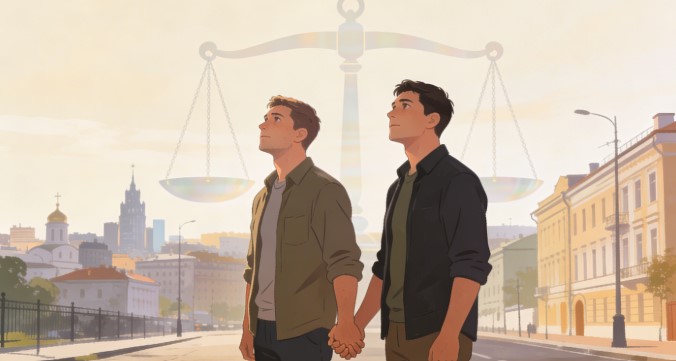
The ruling, however, does not introduce marriage equality or civil unions. Ukraine’s Constitution and Family Code still define marriage strictly as a union between “a woman and a man”, and queer couples cannot register any form of partnership. A draft law on civil partnerships, tabled in 2023 after pressure from civil society and queer soldiers on the front, has been stuck in Parliament for three years. In 2023, the European Court of Human Rights already condemned Ukraine in the case Maymulakhin and Markiv v. Ukraine for failing to offer legal recognition to same-sex couples, stressing that “protecting traditional families” is not a valid excuse to deny basic rights. The Supreme Court’s decision goes in the same direction, but it remains jurisprudence, not a comprehensive legal framework.
Read Also : Queens of Joy: Ukrainian Drag, Queer Resistance and Why Our Solidarity Still Matters
Practically, recognition as a de facto family can still matter a lot. It may help same-sex partners claim joint property, inheritance, or decision-making in emergencies, at least when they can convince a court that their relationship meets the same criteria as a heterosexual de facto union. It also tells lower courts that queer couples exist in law, not just in society, which can influence future cases on pensions, social benefits or residence rights. At the same time, activists warn that a new draft Civil Code currently under discussion would explicitly define family as the cohabitation of a man and a woman and could wipe out this fragile progress if adopted. The battle now moves to the political arena, where Ukraine’s commitments to the European Union and the visibility of LGBTQ+ people in the army and in civic life are putting pressure on lawmakers to finally legislate.
Read also : Why You Absolutely Must Watch This Documentary “Mister Nobody Against Putin” on ARTE
For queer communities watching from Brussels, Kyiv or elsewhere, the message is mixed but powerful. No, Ukraine has not “legalised same-sex marriage”, despite some viral headlines. But yes, its highest court has just said out loud that two men who live, love and build a life together are a family – even when politicians still refuse to write it into the law. In the middle of war and displacement, that recognition is not only symbolic: it is a reminder that queer lives and relationships are part of the future Ukraine is fighting for.
KET Magazine is a community‑driven, non‑profit magazine run by volunteers based in Brussels. Get in touch to share your thoughts or tell us about your activities. You can also promote your events on our website or support our work with a donation. Contact us at Info@ket.brussels.
You may also like
-

Türkiye’s LGBTQIA+ Community Faces a New Wave of Pressure
LGBTQIA+ people in Türkiye are living through a sharp escalation in state pressure: Pride events
-

Fiji Declares a National HIV Emergency — and the World Must Pay Attention
Fiji has declared a national HIV emergency after a dramatic rise in diagnoses: 2,016 people
-

Balkan Trafik! Turns Brussels’ Bourse into a Three-Day Balkan Universe
After a year away, Balkan Trafik! returns to Brussels from 19 to 21 November 2026
-

In Myanmar, the Spirit Wives Keep Dancing
Near Mandalay, in a country torn apart by civil war, the annual Taungbyone festival has
-

Five Equality Champions Remind WorldPride What Queer Progress Looks Like
On 5 August, during the WorldPride Human Rights Conference in Amsterdam, UNDP and ILGA World