
For decades, anti-LGBT+ voices have recycled the same tired story: that queer people form a secret lobby manipulating politics against “the majority.” It is a conspiracy theory, not an analysis — and it has always served one purpose: to turn a persecuted minority into a convenient enemy. In France alone, anti-LGBT+ offences reached 4,800 recorded incidents in 2024, while Europe-wide surveys show harassment and violence remain alarmingly high.
A political weapon, not a fact
The phrase “LGBT lobby” is not neutral vocabulary. It is an ideological weapon, popularized by the far right to suggest that LGBT people are not citizens defending their rights, but an invisible power bloc pushing society off course.
That framing is deeply dishonest: it takes a community that has historically been criminalized, pathologized, and attacked, and recasts it as a dominant force supposedly controlling the state.
The same old conspiracy, repackaged
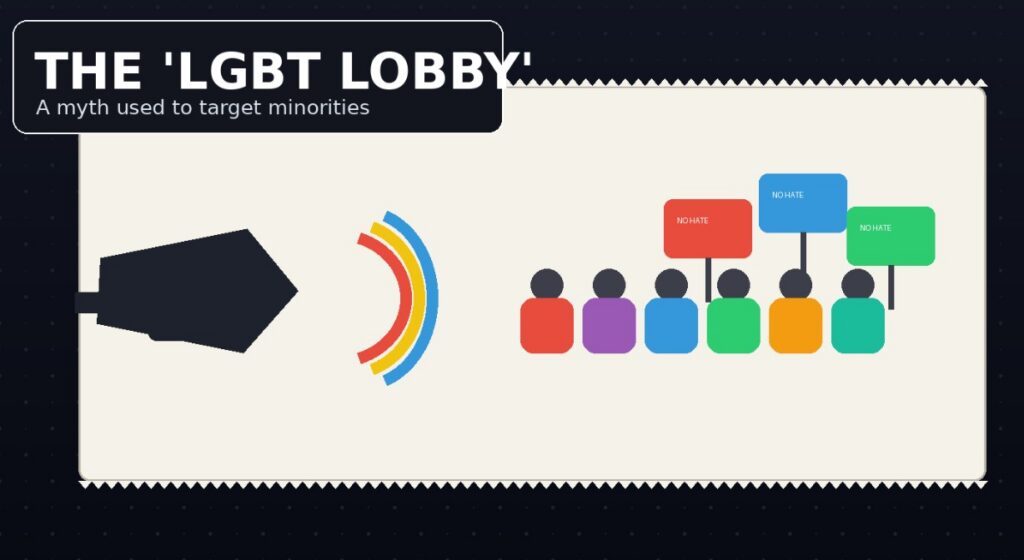
This story is ancient. From the Dreyfus Affair to the Eulenburg scandal, from McCarthyism to modern far-right media, queer people have repeatedly been accused of forming shadow networks that threaten national order.
In reality, the pattern is always the same: stigmatize a minority, invent hidden influence, and use panic to justify discrimination.
Read also : Safer on Paper, Not in Reality”: ILGA Warns of Rising Anti-LGBTQIA+ Violence in Belgium
What the numbers actually show
The facts point in the opposite direction. France’s Interior Ministry recorded 4,800 anti-LGBT+ offences in 2024, up 5 percent from the previous year, with crimes and misdemeanours also rising.
At the European level, the Fundamental Rights Agency says harassment and violence against LGBTIQ people remain at high levels, with more than one in two respondents reporting hate-motivated harassment.
That is not the profile of a powerful lobby; it is the reality of a community still living under pressure.
Why the lie matters
Calling LGBT people a “lobby” is useful for one reason: it launders prejudice into something that sounds like civic concern. It lets politicians attack equality while pretending they are merely defending “common sense” or “the majority”.
But there is nothing democratic about scapegoating. When queer people are described as a hidden threat, the result is always the same: more stigma, more hostility, and more violence.
The real agenda
The real agenda is not LGBT control. It is anti-LGBT backlash. It is the organized effort to roll back rights, normalize hate speech, and make discrimination sound respectable.
If there is a lobby in this story, it is the anti-LGBT lobby — and it has been far more effective at shaping fear than queer people have ever been at controlling the state.
Useful links
- France Interior Ministry, anti-LGBT+ offences in 2024: https://www.interieur.gouv.fr/actualites/grands-dossiers/ministere-sengage-contre-lhomophobie-et-transphobie/legere-progression
- DILCRAH, National Plan for Equality and the Fight Against Anti-LGBT+ Hatred and Discrimination (2023–2026): https://www.dilcrah.gouv.fr/files/files/Plan-national-pour-egalite-lutte-contre-haine-discriminations-anti-LGBT-2023-2026%20EN_2_.pdf
- ILGA-Europe, France Rainbow Map / Annual Review: https://rainbowmap.ilga-europe.org/countries/france/
- ILGA-Europe, 2024 Rainbow Map PDF: https://www.ilga-europe.org/files/uploads/2024/05/2024-rainbow-index.pdf
- Vie publique, anti-LGBT+ offences up 5% in 2024: https://www.vie-publique.fr/en-bref/298584-homophobie-des-chiffres-en-hausse-en-2024
- TÊTU explainer on the “LGBT lobby” myth: https://tetu.com/2022/09/28/lobby-lgbt-ressorts-arnaque-inventee-extreme-droite/
KET Magazine is a community‑driven, non‑profit magazine run by volunteers based in Brussels. Get in touch to share your thoughts or tell us about your activities. You can also promote your events on our website or support our work with a donation. Contact us at Info@ket.brussels.
You may also like
-
Liège’s Maison Arc-en-Ciel Needs Support to Keep Its Doors Open
Maison Arc-en-Ciel de Liège, a vital LGBTQIA+ community hub in Wallonia, is facing growing financial
-

Garden Party de la Maison Arc-en-Ciel de Liège
Liège’s Maison Arc-en-Ciel is bringing back its annual Garden Party on Saturday 5 September 2026.
-
IGLYO Wants to Hear From You: Europe’s Biggest LGBTQI School Survey Is Back
IGLYO, the Brussels-based international LGBTQI youth network, has just launched the second edition of its
-

Back To Brussels? BGS Is The LGBTQI+ Sports Community Waiting To Meet You
September means fresh starts, new routines and, for a lot of people landing in Brussels
-

Sensuelle: A Softer Space to Explore Desire, Connection and Self-Expression
Sensuelle is creating warm, women-centred spaces where sensuality can be explored without performance pressure, shame