

When Poland’s new government came to power, manyqueer people allowed themselves a cautious sigh of relief. After years of “LGBT‑free zones” and open hostility, the pro‑European coalition led by Donald Tusk sounded like a fresh start. But as Dutch LGBTQ+ magazine Winq reports, that hope is already cracking – especially around one concrete issue: recognition of same‑sex marriages performed in other EU countries.
Thanks to ELMA – the European LGBTQIA+ Magazines Association, ket can share and adapt this reporting from Winq. Because what happens in Warsaw matters in Brussels too.
What the EU court said – and what Poland is (not) doing
In November 2025, the Court of Justice of the European Union ruled that all EU member states must recognise same‑sex marriages legally concluded in another EU country, at least for the purpose of free movement and family life. The case involved a Polish couple who had married in Germany and wanted their marriage registered back home. Poland refused, arguing that its national law does not allow same‑sex marriage.
The EU court was clear: a country does not have to open marriage domestically, but it cannot pretend a foreign same‑sex marriage doesn’t exist when it comes to things like residence rights, access to services or family life. If a straight couple’s German marriage is recognised on return, the same must apply to a gay or lesbian couple.
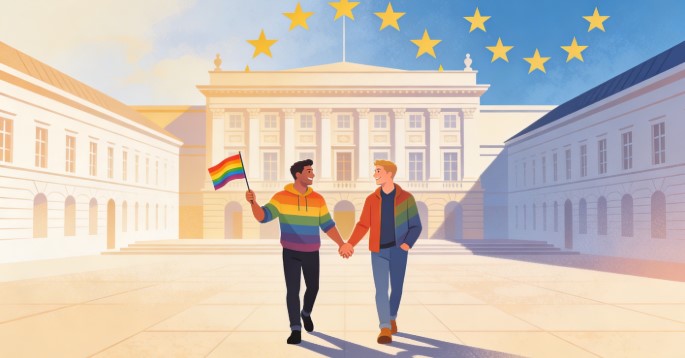
Following that decision, Poland’s administrative supreme court issued a breakthrough ruling: a same‑sex marriage registered in another EU member state must be entered into the Polish civil registry. On paper, that looked like a turning point.
Read also : Poland’s Supreme Administrative Court Recognises Same-Sex Marriages from Other EU Countries
But as Winq points out, the reality is messy. Prime minister Donald Tusk has sent mixed signals over time, at moments saying Poland would respect EU law and recognise such marriages, at others insisting that “Polish law” remains the limit and pushing the issue back onto courts and bureaucratic procedures. For couples who have waited years to see their families acknowledged, that hesitation feels like a refusal.
“We feel betrayed”
The headline of Winq’s article is blunt: “Polish queers feel betrayed by prime minister Tusk”. After campaigning against the openly homophobic PiS government and promising a more rights‑friendly direction, Tusk is now seen by many activists as dragging his feet.
Queer couples who married in Spain, Germany, the Netherlands or Belgium describe a familiar pattern:
- local registry offices still refusing to transcribe their marriage certificates
- endless paperwork and appeals
- being treated as legal strangers when they return to Poland, despite a valid EU marriage.
One activist quoted by Winq sums it up: under PiS, expectations were low and hostility was explicit. Under Tusk, expectations were high – and disappointment cuts deeper. When a supposedly progressive government hesitates to implement court rulings, “you feel like a pawn in a political game rather than a citizen with rights”.

Symbolic moves vs. everyday reality
Since taking office, the Tusk government has made some symbolic and legal shifts:
- moving to replace “man” and “woman” with gender‑neutral “first spouse” / “second spouse” in certain civil status templates, to make recognition of foreign marriages technically possible
- speaking about registered partnerships as a future goal
- apologising publicly to same‑sex couples for “years of rejection and humiliation”, and promising to implement court decisions “as soon as possible”.
On paper, these are real changes. But Winq highlights the gap between statements in Brussels and experiences on the ground in Poland. Administrative offices can still stall, judges can interpret the rules narrowly, and the Catholic‑nationalist opposition is ready to weaponise any move on LGBTQ+ rights.
For queer people who have lived through years of homophobic rhetoric, “wait a bit longer” is a hard sell.
Why this matters beyond Poland
From Brussels, it might be tempting to see this as a “Polish debate” far away. But for EU citizens, the issue cuts right through the idea of a shared European space.
The EU court ruling reminded everyone that freedom of movement includes family life. You should not have to choose between your marriage and your passport, or between living in safety abroad and seeing your relationship erased when you go back home. When a member state drags its feet on recognising EU marriages, it undermines that principle.
For ket’s readers, there’s another angle: many Polish queers live, work and love in Brussels. Some are married here, some dream of returning one day, others keep shuttling between cities. What happens in Warsaw will decide whether their relationship is respected or ghosted by their own state.
Source and network
This article is based on and adapted from:
- “Poolse queers voelen zich verraden door premier Tusk: hij weigert huwelijken te erkennen uit andere EU‑lidstaten”, published by Dutch LGBTQ+ magazine Winq in 2026.
We can share this story in English on ket thanks to ELMA – the European LGBTQIA+ Magazines Association, which connects queer media across Europe and lets us amplify each other’s reporting.

KET Magazine is a community‑driven, non‑profit magazine run by volunteers based in Brussels. Get in touch to share your thoughts or tell us about your activities. You can also promote your events on our website or support our work with a donation. Contact us at Info@ket.brussels.
You may also like
-
Türkiye’s LGBTQIA+ Community Faces a New Wave of Pressure
LGBTQIA+ people in Türkiye are living through a sharp escalation in state pressure: Pride events
-

Fiji Declares a National HIV Emergency — and the World Must Pay Attention
Fiji has declared a national HIV emergency after a dramatic rise in diagnoses: 2,016 people
-

Balkan Trafik! Turns Brussels’ Bourse into a Three-Day Balkan Universe
After a year away, Balkan Trafik! returns to Brussels from 19 to 21 November 2026
-

In Myanmar, the Spirit Wives Keep Dancing
Near Mandalay, in a country torn apart by civil war, the annual Taungbyone festival has
-

Five Equality Champions Remind WorldPride What Queer Progress Looks Like
On 5 August, during the WorldPride Human Rights Conference in Amsterdam, UNDP and ILGA World