
IGLYO, the Brussels-based international LGBTQI youth network, has just launched the second edition of its pan-European LGBTQI School Survey, open until September 30, 2026. Aimed at LGBTQI people aged 15 to 24 who have attended school anywhere in the Council of Europe region (plus Russia, Belarus and Kosovo), the anonymous survey takes about 15 minutes and is available in more than 15 languages. Its goal is simple but crucial: turning lived experience into hard data that policymakers can actually use to make schools safer. For a generation of LGBTQI students still facing bullying and discrimination in classrooms across the continent, filling it out is a small act with a potentially lasting impact.
A Brussels organisation with a European mission
IGLYO, the International LGBTQI Youth and Student Organisation, has been based in Brussels since it became a registered non-profit in the city in 2009. From its offices in Ixelles, the network now represents the voice of over 150 member organisations in 40 countries across Europe, making it the largest LGBTQI youth network in the world (IGLYO). Its work spans advocacy, research, training and international events, all built around one core mission: protecting and empowering LGBTQI young people under 30.
This survey is one of its flagship tools. First run a few years ago, it became the most comprehensive study of its kind on LGBTQI students’ experiences at school in the European region, and this second edition aims to go even further.
What the survey actually asks
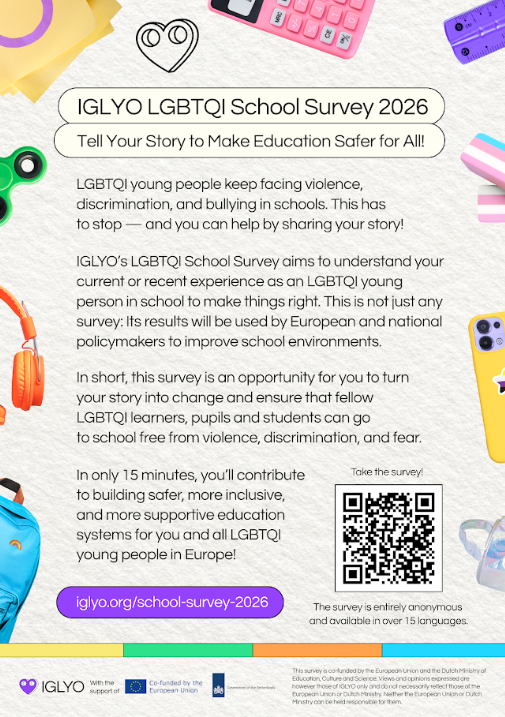
The questionnaire, developed together with IGLYO’s member organisations, covers a wide range of topics: school policies, experiences of discrimination and bullying, mental health and wellbeing, gender recognition, and overall inclusion at school. It’s designed for anyone aged 15 to 24 who currently attends, recently graduated from, or had to leave school in a Council of Europe country, Russia, Belarus or Kosovo — whether that experience was positive, difficult, or somewhere in between.
Participation is entirely anonymous and confidential, takes roughly 15 minutes, and is available in more than 15 languages to make it as accessible as possible across the region.
Why this matters for LGBTQI students today
LGBTQI young people continue to face some of the highest rates of violence, discrimination and bullying in school environments across Europe. Surveys like this one exist precisely because those experiences are too often invisible in official statistics, which makes it harder for governments and school administrations to justify concrete action.
By collecting first-hand accounts at this scale, IGLYO intends to produce both a comprehensive Europe-wide report with key findings and recommendations, and country-specific reports that local organisations can use directly for advocacy. In other words, every response feeds into arguments that member organisations across 40 countries can bring straight to their own ministries of education. For a young person filling in the form, that’s 15 minutes of anonymous honesty translated into a tool for systemic change.
A call that goes beyond students themselves
IGLYO is also asking allies, teachers, parents and organisations who are not eligible to take the survey themselves to help share it as widely as possible. The more representative the sample, the more weight the results will carry with European and national policymakers — so spreading the word matters almost as much as answering the questions.
Practical information
The IGLYO LGBTQI School Survey 2026 is open to LGBTQI people aged 15–24 who have attended school in a Council of Europe country, Russia, Belarus or Kosovo. It is anonymous, takes about 15 minutes, is available in over 15 languages, and closes on September 30, 2026. The survey can be accessed at iglyo.org/opportunities/school-survey-2026. For questions, IGLYO’s Comms & Network Team can be reached at network@iglyo.org. The survey is co-funded by the European Union and the Dutch Ministry of Education, Culture and Science.
Fifteen minutes, one anonymous form, and a chance to shape safer schools for the next generation of LGBTQI students across Europe — from right here in Brussels.
KET Magazine is a community‑driven, non‑profit magazine run by volunteers and based in Brussels. You can find our other music and nightlife stories on ket.brussels, and you can always write to us to share your projects or pitch a story: info@ket.brussels
You may also like
-
Mideterms Elections in US – The Closetocracy: when the closet becomes a question of power
The Closetocracy, now available on YouTube through The Young Turks, puts secrecy, sexuality and political
-

Beyond the rent rant: Bruscope puts Brussels life under the lens
Why does finding a home in Brussels feel so complicated? Who does the work that
-

At Liège’s Queer Families Festival, Every Family Has a Story
The third edition of the Queer Families Festival takes place on 11 October at the
-

“After”: Listening to LGBTQIA+ Survivors Speak About Intimate Partner Violence
On 8 October, Tels Quels invites people to Les Grands Carmes in central Brussels for
-
Liège’s Maison Arc-en-Ciel Needs Support to Keep Its Doors Open
Maison Arc-en-Ciel de Liège, a vital LGBTQIA+ community hub in Wallonia, is facing growing financial