
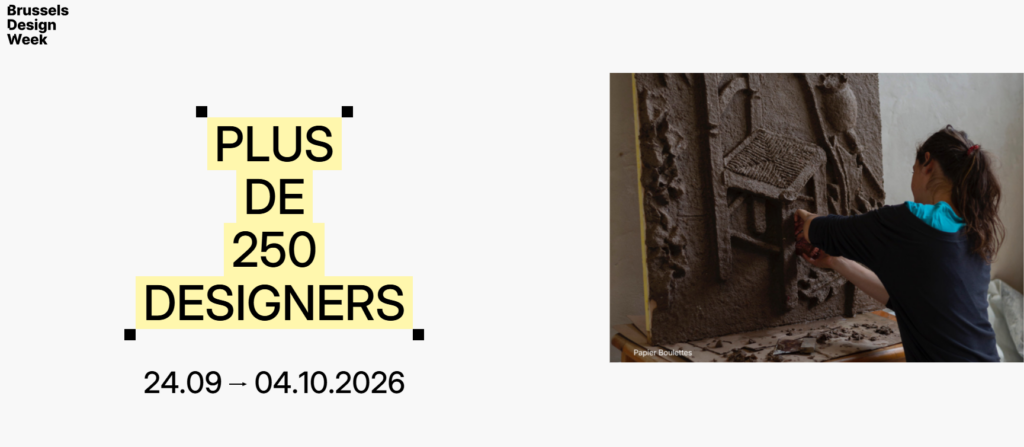
Brussels Design September is becoming Brussels Design Week for its 20th edition, running from 24 September to 4 October 2026. Across the capital, exhibitions, studio visits, talks, installations and workshops will invite the public into the worlds of Belgian and international design. For queer audiences, it is also a useful moment to ask who design is made for — and how objects, spaces and visual culture can make everyday life more inclusive, accessible and open to difference.
A new name, a wider city
For two decades, Brussels Design September has placed design in galleries, shops, studios, schools and public-facing spaces across the city. In 2026, the festival adopts a new name: Brussels Design Week.
The rebranding is intended to strengthen the event’s international profile and connect it more clearly with the wider network of design weeks. But the core idea remains recognisably Brussels: design does not live only in museums or luxury showrooms. It exists in the chair you sit on, the poster you notice on the way home, the café where you meet friends, the public bench that welcomes — or excludes — certain bodies.brusselstimes+1
The anniversary edition brings together more than 100 events across the capital, with exhibitions, conferences, debates, open studios, workshops and encounters with designers.
Design is never only decorative
Design can be beautiful, playful or strange. It can also decide how comfortably we move through the world.
Who can enter a venue without encountering stairs? Who can understand the information on a sign? Who has access to a bathroom that respects their gender identity? Who is assumed to be the “default” user when furniture, clothing, public transport, websites or urban spaces are designed?
These questions are particularly relevant for LGBTQIA+ people, disabled people, racialised communities and anyone whose body, identity or household does not fit traditional norms. Inclusive design is not a niche concern. It is about making room for a wider range of lives.
Brussels Design Week does not present itself as a specifically queer festival, but its broad city-wide format creates plenty of potential for queer readings. The most interesting design often emerges when it refuses the idea that there is one normal body, one normal home or one normal way to live.
From gardens to experimental materials
The 2026 programme includes a series of exhibitions and events that move beyond the familiar world of designer furniture.
At USquare, the immersive exhibition “A Garden Party” explores the party as a space for meeting, creation and collective reflection. That theme has obvious resonance for queer communities: gatherings can be joyful and political at once, offering room to imagine social relations differently.
Elsewhere, “Les Jardiniers du Vide” in Ixelles spotlights Zélie Boulestreau’s Papier Boulettes project, while Curated returns to Mix Brussels for its third edition as an accessible exhibition of collectible design. The latter runs from 25 to 27 September and includes talks, food, music and a weekend-long public programme. Entry is free, though tickets are required.dhnet+1
For a more experimental direction, MATERIATEK — Off the Grid brings together contemporary designers whose work challenges conventional approaches to making and presenting design. The exhibition runs from 24 to 27 September.
Open studios, less gatekeeping
One of the strongest elements of a city-wide design festival is the chance to step into the places where things are actually made. Studios and workshops open their doors, offering a glimpse behind the polished final object.
That matters because creative industries can sometimes feel closed-off: expensive education, professional jargon, insider networks and the sense that design is “not for us” can all keep people at a distance. Open studios do not erase those barriers, but they can make the field feel less mysterious.
During the opening-studio weekend from 25 to 27 September, visitors can meet designers and see working spaces across Brussels. Among the participating initiatives, Design for Resilience plans an opening drink on 25 September and invites visitors into its workshop.designforresilience
For queer creatives, students and curious audiences, it is an opportunity to encounter practices that may offer new ways of thinking about self-expression, sustainable making, collective work and the spaces we call home.
A festival for looking differently
Brussels Design Week is worth approaching with curiosity rather than an obligation to understand every object, term or trend. Design is not always immediately legible — and it does not need to be.
The most rewarding visits may be the ones that make you pause: a chair that changes how you think about rest, a poster that complicates an image of the city, a piece of material research that turns waste into possibility, or a room that makes you feel unexpectedly welcome.
In a city as layered and diverse as Brussels, design can help create more than beautiful things. It can make visible whose needs have been overlooked — and offer concrete ways to imagine environments where more people can belong.
Practical information
What? Brussels Design Week 2026, formerly Brussels Design September
When? Thursday 24 September to Sunday 4 October 2026
Where? Multiple venues across Brussels, including galleries, studios, cultural institutions, shops, hotels and heritage spaces
Programme: More than 100 events, including exhibitions, talks, workshops, open studios, installations, debates and design encounters
Highlights: A Garden Party at USquare; Les Jardiniers du Vide in Ixelles; Curated at Mix Brussels, 25–27 September; MATERIATEK — Off the Grid, 24–27 September
Tickets: Many events are free or have their own admission conditions; check each listing before visiting. Curated is free with advance ticket reservation.designseptember
More information: Brussels Design Week programme and City of Brussels overviewbruxelles+1
A city-wide design week is an invitation to look closer — at the objects around us, the places we share and the many people who deserve to feel at home in them.
KET Magazine is a community‑driven, non‑profit magazine run by volunteers and based in Brussels. You can find our other music and nightlife stories on ket.brussels, and you can always write to us to share your projects or pitch a story: info@ket.brussels
You may also like
-
Two nights, different gears: Rave Rebels turns up the volume in Brussels
Rave Rebels returns to Brussels’ ING Arena on 6 and 7 November 2026, bringing Faithless,
-
FrancoFaune 2026: Brussels, Turn Up the Volume
From 1 to 11 October, FrancoFaune returns for its 13th edition, spreading French-language music across
-
Pink Screens Turns 25 — and Brussels’ Queer Cinema Is Still Coming Home Late
From 28 October to 7 November 2026, Pink Screens returns to Brussels for its 25th
-
Circle Park Prepares One Last Summer Dancefloor in Brussels
Circle Park is bringing its summer season to a close with a two-day Closing Weekend
-
Balkan Trafik! Turns Brussels’ Bourse into a Three-Day Balkan Universe
After a year away, Balkan Trafik! returns to Brussels from 19 to 21 November 2026