

Orlane has never hidden her queerness. In ROUGE À LÈVRES, desire for a woman slips into the story like a non‑event. Pronouns are left vague, as if the song quietly refuses to dramatise her identity. With AMOUR PLURIEL, everything becomes sharper. The track crackles with a new kind of clarity, a queer electro‑pop anthem that refuses to whisper. It’s still intimate, but it’s louder in every sense. The desire is more direct, more outspoken, and the Belgian artist gets more deliberately herself than ever before.
Meet Orlane
We met Orlane on a Friday night, right before her performance at the mythical C12 nightclub in Brussels. Flickering lights, smoke machines, and young hearts dancing to the thrilling rhythms of pop divas and queer icons. With a bold, fresh haircut, purple glittery eyeshadow, and the edgy look of the next queer Belgian superstar, she greets us with the warmth of that one best friend who just gets it.
“I feel like I’m moving more and more towards a raw, stripped‑down writing style.”
Orlane on Carrying the Fire
Visibility always comes with noise, and Orlane is no stranger to the uglier corners of the internet. Coming out more openly, especially in an ecosystem that rewards outrage, has meant facing comments that sting, that try to shrink her. But she has also seen the other side: her queer listeners telling her this is the first time they heard themselves in a Belgian pop song. Those messages, she says, have slowly reshuffled her priorities and taught her that the more honest she is, the more she builds a community, not just an audience.
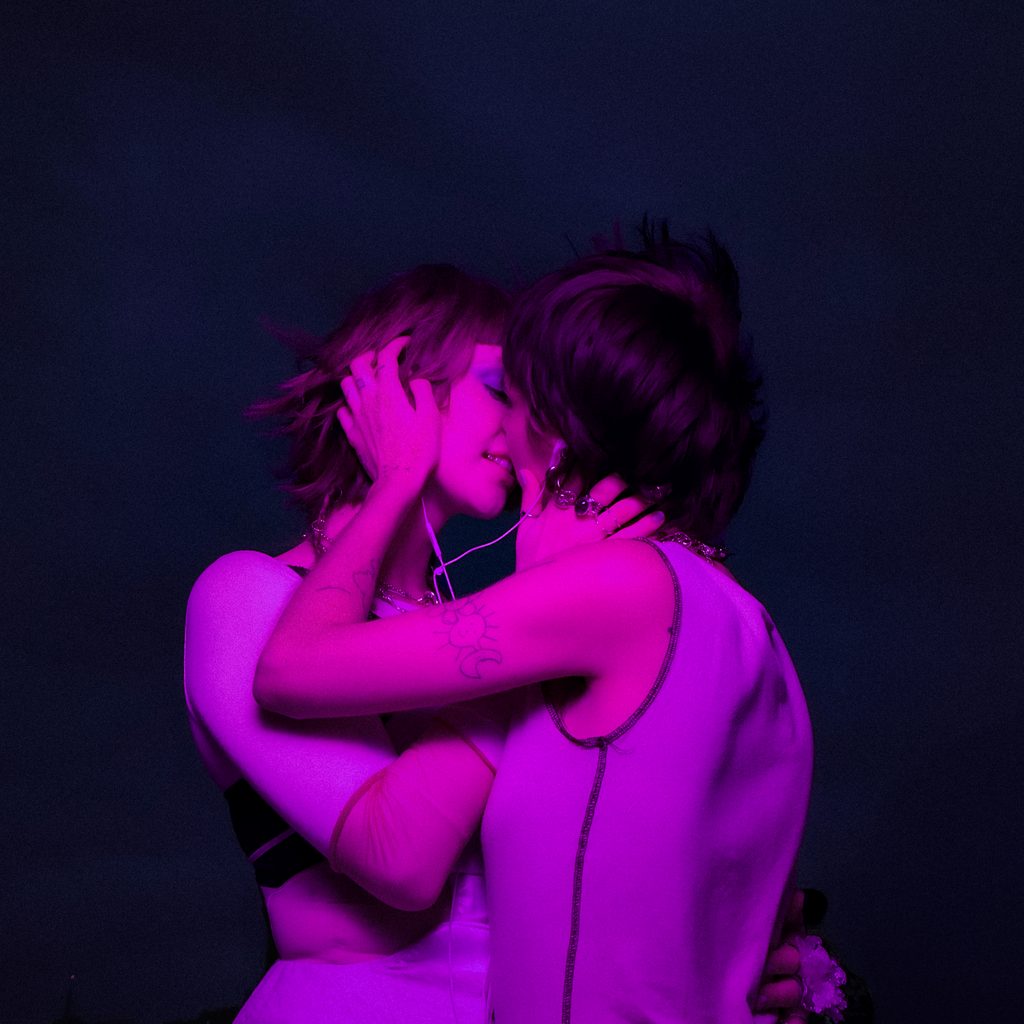
She opened up to us about her upbringing, being born and raised in the little town of Philippeville in the Belgian countryside, a place where queer representation doesn’t exactly sprout up on every corner. Yet at some point something shifted.
The desire to get raw and more outspoken, she says, came together in layers rather than in one sudden revelation: a breakup that left her feeling freer, a militant circle that sharpened her view of the world, the constant love-hate relationship with social media, and, of course, Brussels. All these elements turned her anger into something she could channel into music. Music as a channel for change, for growth. She feels an urgent need to write without disguise, to put herself fully on paper, and to turn that long-held silence into a song that finally says where she comes from and who she is. AMOUR PLURIEL is cheeky, grown, and clearly the Pride anthem we needed.
“I don’t take it personally, because I know I’m aligned with my values. I know I’m spreading a message of love, tolerance, and respect. When hate is directed at me for that, it feels like a reflection of the other person’s struggle, not of what I stand for, so it leaves me completely unfazed.”
The Urge to Fight
In a world where LGBTQIA+ rights are receding in many countries, choosing to be more visible feels, for her, like a political act as much as a personal one. But not from a place where every queer person should be expected to follow her path. It is a personal choice, a calling, and she feels confident to fight the fight for those who do it in silence.
“I understand that some people stay in their bubble and don’t have the energy or the desire, you know, to fight and all that. For me, it’s really kind of an urge: I need to revolt, I like defending our values, I like fighting for them, carrying that struggle, advocating for them and all. I think it’s important that there are people who take that on for those who don’t have the energy or the courage, and who can be there saying, ‘Don’t worry, we’re handling this for you’—but I still think it’s important.”

Cutting the Hair, Sharpening the Sound
Musically, the new track signals a new phase, but also a doorway: the last hurrah to her debut album, ALLER-RETOUR. The song arrives less than a year after her first LP, a period during which she threw herself fully into touring, promo, and performances, from Belgium to Japan, to an NRJ Music Award under her belt. “I defended that album like crazy,” she says, then laughs. “I feel like I’ve grown a lot in just one year since that album came out, and I thought it was important to do kind of an update, with a track that pulls together a lot of the sonic threads from the record.” The new look, the cut‑back hair, the bolder aesthetic. All of it echoes the song’s more direct tone, more assumed identity, and more intentionally raw sound.
To Those Celebrating in Silence: Orlane’s Pride Message
With the Brussels Pride right around the corner at the time of the interview, we ended our talk acknowledging our privileges. The privilege to even have these conversations out in the open, without being silenced by the environment we live in. “I would send so much love, courage, and strength,” she wishes to whoever might celebrate Pride from afar, waiting for the right moment to live their truth.
“I think what helps is knowing there are people who understand you, people who are part of your community and who will welcome you with open arms. And I think it’s also OK to keep your private garden, to take the time you need to be ready, to cross that threshold, and to go looking for that love and that solidarity in another kind of family, one that can hold you at that level. There are so many lovely people out there who are there to welcome everyone with open arms, and I think that does something to you: it helps you really accept that part of yourself.” – Orlane
With Amour Pluriel, Orlane is not simply announcing a new musical chapter. She is making room for queer desire, honesty, and softness to exist loudly in Belgian pop. And we all know how needed that is.
KET Magazine is a community‑driven, non‑profit magazine run by volunteers and based in Brussels. You can find our other music and nightlife stories on KET.brussels, and you can always write to us to share your projects or pitch a story: info@ket.brussels
You may also like
-
Arkane Takes 200 Rock Voices Across Belgium, With Alice on the Roof at AB
From Marche-en-Famenne to Brussels Two hundred voices, a live band and a setlist ranging from
-

FIVE QUESTIONS… AND ONE BONUS – Meet Tristan Jon, painter
Music, movement, Brussels and the poetry of blur: painter Tristan Jon talks about the art
-
RIRE: A Queer Cabaret Against Taking Everything So Seriously
What if laughing could be a way of resisting? With RIRE (pour en finir avec
-
Tendre feu: Burning Down the Script of Masculinity
What if masculinity did not have to mean control, silence or violence? With Tendre feu
-

Nathanaël & The Horde of Travesties Bring Folk-Rock to Ixelles
A garden bar, summer drinks, games and a band with “travesties” in its name: the