
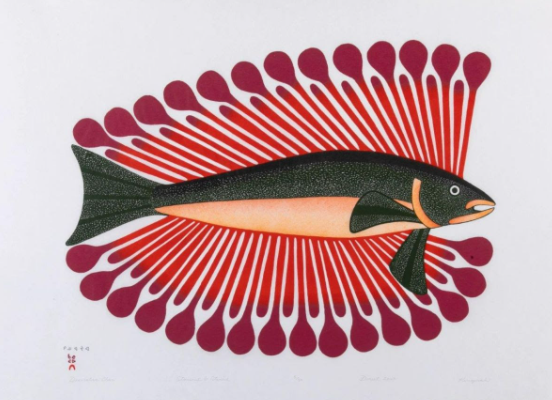
From 16 October 2026 to 18 April 2027, the Art & History Museum in Brussels presents Inuit – Impressions of the Canadian Far North, a major exhibition devoted to contemporary Inuit art from Nunavut and Nunavik. Bringing together nearly 250 sculptures, drawings, prints and other graphic works, the show traces around seven decades of artistic creation while placing Inuit artists’ own voices at its centre. For queer audiences, its relevance lies in its refusal to flatten identity: it invites visitors to encounter living, diverse artistic practices shaped by land, memory, gender, social change and climate justice.
Beyond the Arctic postcard
European audiences have often encountered Inuit art through a limited lens: sculpture, “tradition”, polar landscapes, perhaps a familiar image of snow and ice. Inuit – Impressions of the Canadian Far North sets out to move beyond that narrow frame.
The exhibition focuses on contemporary artists from Nunavut and Nunavik, two major Inuit regions in the Canadian Arctic. Rather than treating their work as ethnographic evidence of a culture frozen in time, the museum presents it as art: ambitious, varied and deeply connected to the present. The artists’ own comments on their works are included throughout the display, helping visitors meet the ideas, stories and questions behind the images.
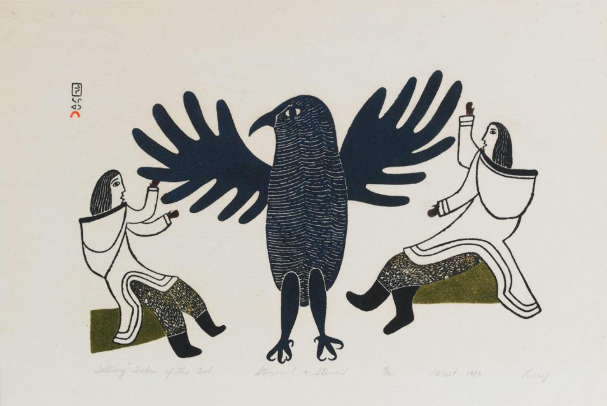
Lucy Quinnuayuak Telling tales of the owl 1983 gravure sur pierre
That distinction matters. Museums have a long history of speaking about Indigenous communities without giving enough space to people speaking for themselves. Here, the stated aim is to foreground living artistic voices and to build a more attentive relationship with the communities connected to the works.
Prints, drawings and powerful visual worlds
The exhibition gathers nearly 250 works across roughly 70 years of creation. Sculpture is part of the story, but the show particularly highlights graphic art — prints, engravings and drawings — an important field of Inuit creativity that remains less familiar to many European visitors.
Women artists are especially prominent in the exhibition, reflecting their major role in the development and evolution of Inuit graphic practices. Their works form part of a broader artistic landscape where visual language is constantly being renewed: through bold lines, layered colour, graphic storytelling, imagined beings, animals, family histories and changing environments.
Visitors will find artistic worlds shaped by shamanism, mythology, the long polar night, birds, marine life and land animals. But this is not a nostalgic tour of Arctic imagery. The works also engage with social transformation, gender relations, sedentary life, identity, memory and a climate increasingly under pressure.
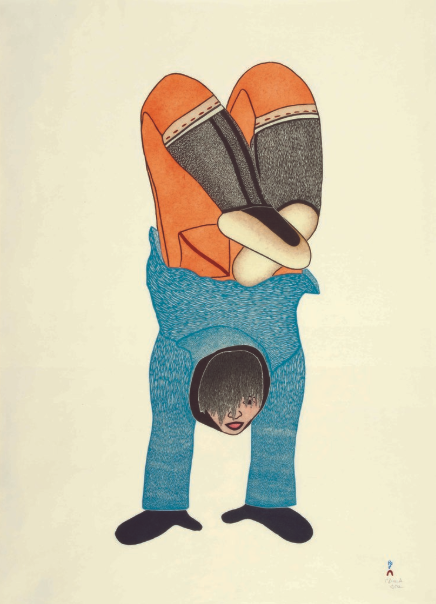
Shuvinai Ashoona Handstand 2010 gravure sur pierre pochoir
Art shaped by land — and change
The Canadian Arctic is often discussed from afar as a symbol of climate crisis. Inuit artists bring something more specific and more human to that conversation: relationships with territory, wildlife, community and environmental transformation that cannot be reduced to an abstract global warning.
The exhibition’s immersive scenography begins with the reconstruction of a large igloo, from which visitors can move through thematic sections. These explore terrestrial and marine animals, birds, the winter darkness that can last for almost four months, printing techniques, the consequences of sedentarisation and a climate in rapid transformation.
For LGBTQIA+ visitors, the exhibition may also resonate through its attention to complexity. Queer communities know the damage done when institutions reduce people to a single story, an identity category or a stereotype. A show that foregrounds artistic agency, multiple generations and diverse perspectives creates a more respectful starting point for engaging with Indigenous art and culture.
That does not mean treating Indigenous and queer experiences as interchangeable. It means recognising a shared cultural question: who gets to represent themselves, whose knowledge is valued, and what happens when museums make space for voices that have too often been spoken over?
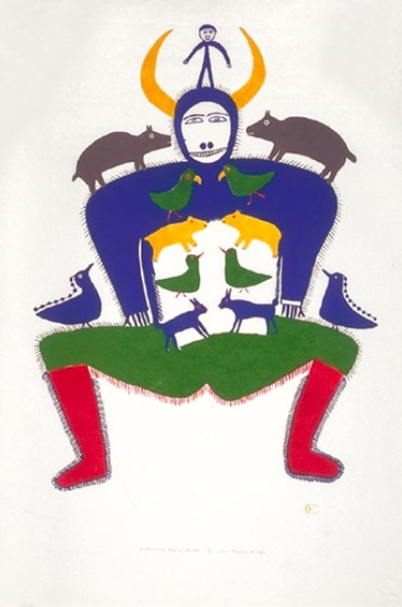
Jessie Oonark A shaman’s helping spirit 1971 gravure sur pierre pochoir
An exhibition built for different audiences
The project is one of the largest exhibitions dedicated to contemporary Inuit art ever presented in Europe. It draws in particular on the collection of Belgian writer and poet Carl Norac, alongside loans from the AfricaMuseum, the Royal Belgian Institute of Natural Sciences, Lyon’s Musée des Confluences, the Musée-Château de Boulogne-sur-Mer and Leiden’s Museum of Ethnology.
The museum is also planning activities around the exhibition, including talks, late openings, family activities, holiday programmes and events linked to Museum Night Fever. A lecture series will run on selected Sundays from 8 November 2026 to 11 April 2027, while late openings are scheduled on selected Thursdays from 19 November 2026 to 15 April 2027.
Accessibility is part of the programme too. The museum offers adapted group visits for blind and visually impaired visitors, an audio tour developed with Créahm, and a family area within the exhibition. Brussels Museums lists the venue as accessible without assistance, although anyone with specific access requirements should contact the museum before visiting to confirm the support that fits their needs.
Practical information
Exhibition: Inuit – Impressions of the Canadian Far North
Dates: Friday 16 October 2026 to Sunday 18 April 2027
Venue: Art & History Museum, Parc du Cinquantenaire 10, 1000 Brussels
Opening hours:
- Tuesday to Friday: 09:30–17:00
- Saturday and Sunday: 10:00–17:00
- Monday: closed
Admission: Standard entry is €18; entry is free with a museumPASSmusées.museumpassmusees+1
Programme highlights:
- Museum Night Fever: 17 October 2026
- Lecture series: selected Sundays, 8 November 2026–11 April 2027
- Late openings: selected Thursdays, 19 November 2026–15 April 2027
- Guided visits and adapted options: booking required for groups, at least three weeks in advance
More information: Art & History Museum — Inuit exhibition
This is not an exhibition about a distant, static “North”. It is an invitation to spend time with artists whose images speak vividly about transformation, imagination and the ongoing work of belonging to a changing world.
You may also like
-
What Happens When We Move Together? The Mechanics of Crowds Comes to Liège
From 20 November 2026 to 4 April 2027, La Cité Miroir in Liège hosts The
-
Bords Perdus: Brussels’ DIY Print Scene Refuses to Disappear
From 25 to 27 September, LaVallée in Molenbeek becomes a three-day home for independent comics,
-
Vigilante: When Justice Turns Into a Trap
What happens when someone loses faith in the institutions meant to protect us — and
-
Can You Prove You’re in Love?
What happens when a queer relationship becomes an administrative test? In Dansen met mijn ex
-

John & Jen: A Small Musical With a Devastating Emotional Punch
At Festival Bruxellons!, John & Jen turns a two-person cast and an intimate barn stage