
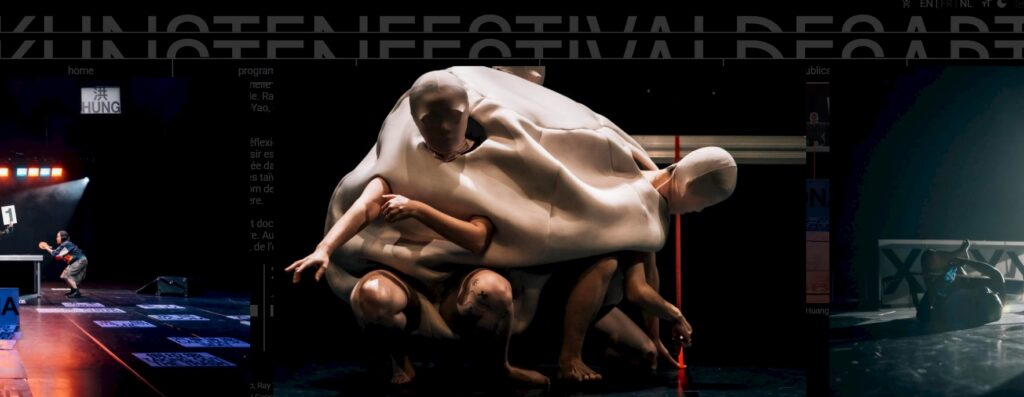
At a time when queer parenthood remains entangled with law, tradition, and social expectations, Family Triangle arrives in Brussels as a work of rare intimacy and political force. Presented as part of Kunstenfestivaldesarts, the performance by Chien-Han Hung, Wei-Yao Hung, and Ray Tseng will be shown at KVS BOX from 27 to 30 May 2026.
What makes the piece especially compelling is that it begins not as a fictional premise, but from the artists’ own lives. Chien-Han and Ray are a married same-sex couple who want to have a child together: Ray would provide the egg, Chien-Han would carry the pregnancy, and Chien-Han’s brother Wei-Yao would provide the sperm so that the child’s DNA would connect both sides of the family.
© Huang Huang Chih
A family shaped by care
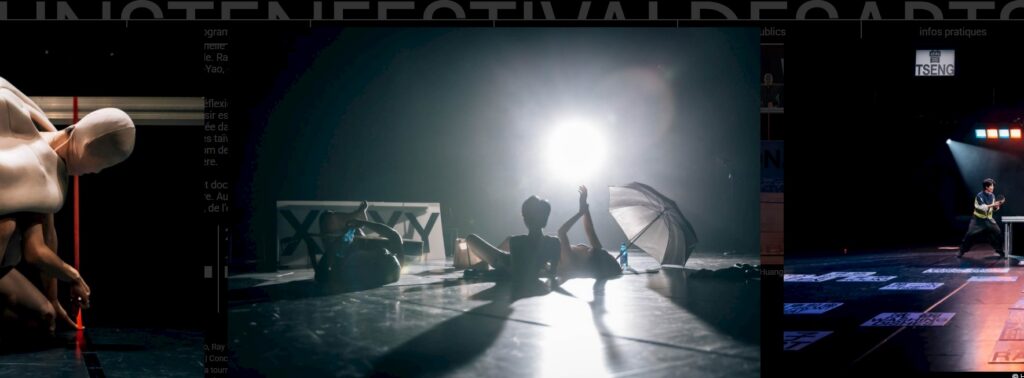
According to the festival description, Family Triangle explores the desire and right to form a family, while confronting the ways tradition, gender expectations, and the law can shape — and sometimes wound — that desire. The performance unfolds through non-chronological scenes, moving between childhood memories, legal reality, and the everyday emotional negotiations that come with building a queer family.
A lawyer appears in the piece to confront the legal framework, while Ray and Chien-Han even play a table tennis match to decide their child’s surname. That combination of humour, documentary material, and political reflection gives the work a particular texture: it is tender without being naïve, and sharp without becoming didactic. Within this triangle, the deepest bond is not DNA, but commitment and care — a truth that laws often fail to recognise.
More than a performance
One of the most striking things about Family Triangle is that it is not merely a performance inspired by queer life; it is rooted in the real-life family structure of the three artists. That makes the Brussels presentation especially resonant, because Chien-Han will reportedly be quite far along in her pregnancy when the work is performed. [user input]
For a KET audience, this is exactly the kind of work that deserves attention. It speaks to queer life not as metaphor, but as lived reality — legal, bodily, emotional, and relational. It also echoes a broader conversation already familiar to KET readers around queer parenting as an act of resistance and reinvention.
Why it matters now
The festival text makes clear that Family Triangle asks whether the traditional heteronormative nuclear family still holds relevance in 2026, in Taiwan and beyond. That question feels especially urgent in a moment when family law, reproductive rights, and recognition of queer kinship remain uneven across countries and legal systems.
What the work offers is not a simple answer, but a lived proposition: that family can be built through intention, mutual recognition, and responsibility rather than biology alone. In that sense, the piece belongs to a wider queer cultural conversation about chosen kinship and the right to define one’s own future.
With its mix of theatre, humour, documentary texture, and real-life stakes, Family Triangle is not just a performance in Brussels. It is a contemporary queer family portrait, one that invites audiences to rethink what love, lineage, and parenthood can look like in 2026.
KET Magazine is a community‑driven, non‑profit magazine run by volunteers based in Brussels. Get in touch to share your thoughts or tell us about your activities. You can also promote your events on our website or support our work with a donation. Contact us at Info@ket.brussels.
You may also like
-
Endless Summer Camp: Scout Rules Meet Queer Desire at Balsamine
Summer might be over, but Sophie Guisset has other plans. From 19 to 28 November
-
Escher in Brussels: Who Said Reality Had to Behave?
Staircases refuse to play by the rules, birds become fish, and two hands draw each
-
When Nuns Go Pirate: A Queer Sacred Thriller at Varia
What happens when lesbian love, religious memory and horror theatre enter a locked convent—and refuse
-

Tels Quels Talent Show: Brussels’ Queer Voices Take the Mic
On Friday 16 October, the Tels Quels Talent Show brings live queer creativity to Les
-

CLELIA Turns Solitude Into a Shared Pop Therapy
The Brussels-based musician opens up to KET about mental health, queer visibility and her new