
From 18 June 2026 to 24 January 2027, the Boghossian Foundation presents Shape of absence at Villa Empain, an exhibition that looks at the cultural tragedy unfolding in Syria since 2011. Built around Hrair Sarkissian’s monumental installation Stolen Past and immersive images of Palmyra by Iconem, the exhibition offers a sensitive reflection on disappearance, memory and resilience.
Syria: a heritage under attack
Once a millennia‑old cradle of civilizations and a major cultural crossroads, Syria has seen its heritage systematically targeted since 2011: deliberate destruction, looting, trafficking of antiquities, and the loss of millions of archaeological objects. Shape of absence does not treat this as a closed chapter, but as a tragedy still in progress, asking how we can look at a heritage that is being erased in real time.
One of the key stories in the exhibition is that of the Raqqa Museum, founded in 1981 and once home to around 8,000 objects spanning a vast historical period. Between 2013 and 2017, when the so‑called Islamic State took control of the city, the museum and its collections were completely looted. Thousands of irreplaceable pieces disappeared; only 880 objects are known to survive today. Stolen Past is one of the rare attempts to give a form to what is now missing.
Iconem
Site archéologique de Palmyre en Syrie , 2018
Toronto Aga Khan Museum
Capture d’écran de la vidéo présentant l’arc monumental, le temple de Baalshamin, le temple de Bel
Stolen Past: 48 lithophanies for missing objects
At the heart of the exhibition, Stolen Past unfolds as 48 lithophanies arranged like funerary steles, creating an atmosphere close to a cemetery of images. Illuminated from behind, these thin translucent plates reveal black‑and‑white images of artefacts that vanished from the Raqqa Museum.
Hrair Sarkissian revives a 19th‑century technique – the lithophany – and combines it with 3D printing on delicate translucent surfaces. In doing so, he documents absent objects by turning their absence into a fragile, glowing presence. The work makes absence visible: it appears as silhouettes, contours and volumes that recall the artefacts without pretending to replace them. Stolen Past asks how communities marked by violence can rebuild a collective memory from images, traces and second‑hand forms rather than from the objects themselves.
Palmyra in 3D: seeing what remains, and what is gone
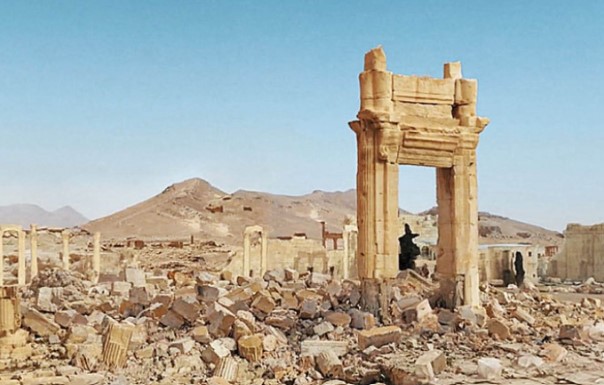
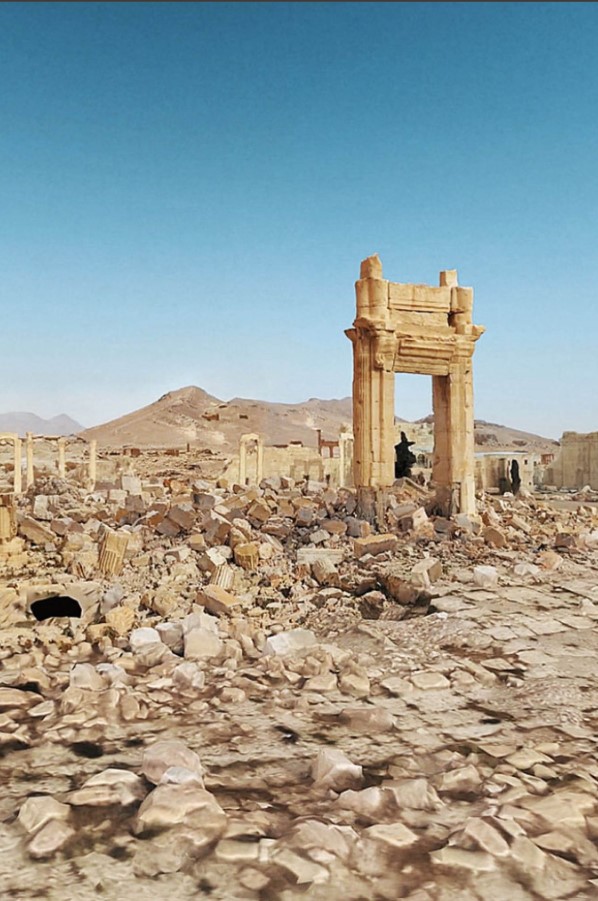
In dialogue with Stolen Past, the exhibition presents immersive images produced by Iconem, a company that digitises and reconstructs endangered heritage sites in 3D. At Villa Empain, visitors find themselves inside the site of Palmyra, weakened both by time and by war.
Between monumental ruins, carved details and silent expanses, the projections invite us to watch not only what remains, but also what is missing. Here too, absence takes shape: in gaps, broken columns, flattened spaces and digital ghosts that 3D models cannot fully bring back. Situated at the crossroads of art, memory and innovation, Shape of absence raises a crucial question: what can a digitised heritage still do when the stones on the ground have been shattered?
Hrair Sarkissian: art between history and trauma
Born in Damascus in 1973, Hrair Sarkissian was trained from an early age in his father’s photography studio before completing a degree in photography at the Gerrit Rietveld Academie in Amsterdam in 2010. Based in London since 2011, he is now widely recognised as one of the major conceptual photographers of his generation.
His practice spans photography, moving image, sculpture, sound and installation, and is deeply rooted in history and memory, often focusing on the long afterlife of political violence. His work has been shown in institutions such as the Fotografisk Center in Copenhagen, the Davis Museum in Massachusetts, the Sursock Museum in Beirut, the Imperial War Museum in London and the BALTIC Centre for Contemporary Art in Newcastle. Stolen Past, presented in London in spring 2026, finds at Villa Empain a new context, in a city where diasporas, archives and contested histories constantly intersect.
Villa Empain as a space for dialogue
By hosting Shape of absence, the Boghossian Foundation continues Villa Empain’s mission as a centre for art and dialogue between Eastern and Western cultures. The exhibition is not just about “beautiful images” of far‑away sites; it is about creating a place where visitors can think together about war, heritage and responsibility.
For Brussels audiences – including Syrian, Armenian and other Middle Eastern diasporas living in the city – the show can become a space of memory, confrontation or mourning. For others, it offers a concrete entry point into issues often perceived as abstract: the destruction of Palmyra, the looting of museums, and the links between armed conflicts, the art market and global tourism. Shape of absence reminds us that cultural heritage is not only about the past; it is also about how we imagine the future after loss.
Practical information
Shape of absence – Boghossian Foundation
- Venue: Villa Empain, Avenue Franklin Roosevelt 67, 1050 Brussels
- Dates: 18 June 2026 – 24 January 2027
- Opening hours: Tuesday to Sunday, 11:00–18:00
- More information: www.boghossianfoundation.be
KET Magazine is a community‑driven, non‑profit magazine run by volunteers and based in Brussels. You can find our other culture and art stories on ket.brussels, and you can always write to us to share your projects or pitch a story: info@ket.brussels.
You may also like
-

Africa Legacy: a different way to look at art history in Brussels
More than 250 works, 22 countries and a conversation across centuries: Africa Legacy – Berceau
-
Inuit Art in Brussels: Women, Gender and Arctic Life
Women artists take a leading role in “Inuit: Impressions of the Canadian Far North” at
-

Endless Summer Camp: Scout Rules Meet Queer Desire at Balsamine
Summer might be over, but Sophie Guisset has other plans. From 19 to 28 November
-

Escher in Brussels: Who Said Reality Had to Behave?
Staircases refuse to play by the rules, birds become fish, and two hands draw each
-
When Nuns Go Pirate: A Queer Sacred Thriller at Varia
What happens when lesbian love, religious memory and horror theatre enter a locked convent—and refuse