
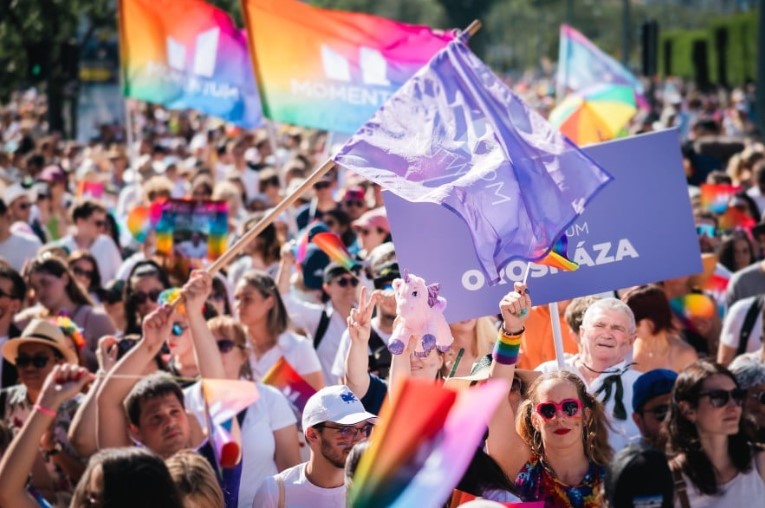
In Hungary, the opposition party Momentum has launched a referendum initiative to allow same‑sex couples to adopt children, directly challenging years of state‑led LGBTphobia. The Hungarian queer magazine Humen Online reports that this move comes at a time when public support for same‑sex couples’ rights is at a historic high, despite Viktor Orbán’s constitutional lockdown on equality. Thanks to the European LGBTQIA+ media network ELMA, of which Ket is a founding member, we can share and amplify Humen’s coverage with our Brussels‑based readers – showing once again that queer struggles and solidarities are deeply interconnected across borders.
A Referendum to Reopen the Door to Adoption
Humen Online explains that Momentum wants to initiate a referendum to restore the right of same‑sex couples to adopt, a right that was effectively blocked when the Hungarian government rewrote the constitution to define family as a union “between a man and a woman” and to bar queer parents from joint adoption. Under Orbán, Hungary has already banned legal gender recognition, limited Pride marches and embedded a rigid, heteronormative concept of “natural order” in its Fundamental Law.
The referendum initiative is both legal and symbolic. Legally, it aims to reverse specific measures that prevent queer families from adopting. Symbolically, it signals that Hungarian opposition parties are willing to anchor LGBT+ rights in their political agenda, rather than treating them as secondary. For many rainbow families in Hungary, this is not an abstract debate: it’s about whether the state will keep treating them as legal strangers to the children they raise.
Read Humen’s original piece (in Hungarian):
- Humen Online – Momentum kezdeményez népszavazást, hogy az azonos nemű párok is örökbe fogadhassanak (Momentum launches referendum so same‑sex couples can adopt).
A Society More Supportive Than Its Government
The Humen article puts the referendum in context by referring to recent polling: a Medián survey shows that a majority of Hungarians would withdraw many of the anti‑LGBTQ+ measures passed in recent years. According to this research, 57% of respondents would cancel laws like the so‑called “child protection” act, the ban on legal gender change and the restrictions on LGBTQ‑themed gatherings.
Even more striking: 68% of those surveyed would allow same‑sex couples to marry and adopt, and 71% support their access to assisted reproduction. These figures sharply contrast with the government’s narrative of “protecting traditional families” and show that Hungarian society is far from unanimously conservative. In other words, the referendum is not just a protest gesture – it taps into a real, growing base of support for equality.
For queer readers in Brussels, where marriage equality and adoption rights are often taken for granted, this is a reminder of how fragile these gains can be elsewhere in the EU, and how important it is to keep watching what happens in countries like Hungary.
ELMA: A Shared European Media Front
Ket is able to bring you this story in detail because we are part of ELMA – the European LGBTQIA+ Media Association. ELMA gathers queer publications, journalists and media professionals from across Europe – including Humen Online (Hungary), Shangay (Spain), Antivirus (Greece), Winq (Netherlands), Means Happy (Spain) and Ket (Belgium).elma+1
The goal is simple but powerful: share resources, amplify each other’s stories and increase the impact of LGBTQ+ media across the continent. When Humen covers a key development in Budapest, that reporting can travel to Brussels, Athens, Madrid or Amsterdam through partner outlets. When Ket writes about Brussels Pride, queer legal fights or local cultural events, these stories can echo in other countries facing similar challenges.
In a context where governments like Orbán’s try to isolate or silence queer voices, this kind of media network matters: it keeps information flowing, builds transnational solidarity and reminds us that no community is fighting alone.
Why This Matters for Brussels and Beyond
From a Brussels perspective, the Momentum referendum initiative speaks to broader European questions. The EU has already clashed with Hungary over its anti‑LGBTQ law, often dubbed a “propaganda law”, and the European Court of Justice has ruled that marginalising LGBTQIA+ people violates EU law. Yet, real change on the ground often depends on national politics and public opinion.facebook+1
Seeing an opposition party openly champion adoption rights for same‑sex couples – backed by data showing majority support – suggests that the story is not over. For queer families living in Belgium but with roots in Hungary, or for activists who work in European institutions, this is both a source of cautious hope and a call to keep pressure high.
Practical Info and Useful Links
- Original article (HU): “Népszavazást kezdeményez a Momentum, hogy az azonos nemű párok is örökbe fogadhassanak” – via Humen Online.
- Main site: https://humenonline.huhumenonline
- Background on public opinion and rights in Hungary:
- Humen article on record‑high support for same‑sex couples’ rights: “Történelmi magasságban az azonos nemű párok jogainak támogatottsága Magyarországon”.humenonline
- Overview of Hungary’s anti‑LGBTQ laws and constitutional changes in recent years (various sources).
- ELMA (European LGBTQIA+ Media Association):
- Website: https://elma.lgbt
If there’s one takeaway, it’s this: while governments can write discrimination into law, they cannot fully control how people evolve. And thanks to networks like ELMA, the stories of those pushing back – from Budapest to Brussels – can travel, inform and inspire others to keep fighting for families, love and legal recognition everywhere in Europe.
Journalist – Kanicsár Ádám András
KET Magazine is a community‑driven, non‑profit magazine run by volunteers and based in Brussels. You can find our other music and nightlife stories on ket.brussels, and you can always write to us to share your projects or pitch a story: info@ket.brussels
You may also like
-

Türkiye’s LGBTQIA+ Community Faces a New Wave of Pressure
LGBTQIA+ people in Türkiye are living through a sharp escalation in state pressure: Pride events
-

Fiji Declares a National HIV Emergency — and the World Must Pay Attention
Fiji has declared a national HIV emergency after a dramatic rise in diagnoses: 2,016 people
-

Balkan Trafik! Turns Brussels’ Bourse into a Three-Day Balkan Universe
After a year away, Balkan Trafik! returns to Brussels from 19 to 21 November 2026
-

In Myanmar, the Spirit Wives Keep Dancing
Near Mandalay, in a country torn apart by civil war, the annual Taungbyone festival has
-

Five Equality Champions Remind WorldPride What Queer Progress Looks Like
On 5 August, during the WorldPride Human Rights Conference in Amsterdam, UNDP and ILGA World