

Portugal, long seen as a frontrunner on trans rights in Europe, is on the verge of dismantling its self-determination law. In a first reading, the Portuguese Parliament has backed plans to reintroduce a mandatory medical opinion for any legal gender and name change – effectively undoing the 2018 reform that allowed people to change their legal gender based on self-declaration from the age of 16. Human rights groups warn this is not a “technical adjustment”, but a political rollback that targets trans and intersex communities.
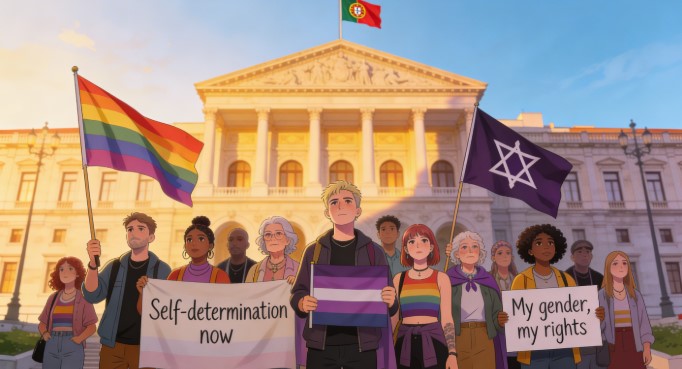
The end of self-determination?
In 2018, Portugal made international headlines by adopting a law that allowed trans people to change their legal gender without a psychiatric diagnosis, starting at 16 with parental consent. This move was hailed by organisations like ILGA-Europe as a major step towards depathologising trans and intersex identities and aligning with human rights standards.
The new proposals adopted in first reading directly attack that core principle. Under the draft laws, anyone seeking to change their legal gender and name will once again need a prior medical opinion. In practice, this would:
- turn legal recognition back into a medicalised process,
- give health professionals gatekeeping power over people’s identities,
- and risk creating new delays, extra costs and arbitrary refusals for trans and intersex people.
For communities who fought to get the 2018 law in place, this is seen as a clear backward step rather than a mere “update” of the system.
Who is pushing the rollback?
Three separate bills have been tabled and approved in first reading. They all come from the current right-wing and far-right majority:
- the centre-right Social Democratic Party (PSD) of Prime Minister Luís Montenegro,
- its conservative ally CDS-PP,
- and the far-right party Chega, now the second-largest political force in the country.
These texts will now be merged into a single bill before a final vote. During the debate, PSD MP Andreia Neto argued that “decisions of this nature should not be taken without the necessary clinical follow-up”, framing the change as a matter of “protection” and “responsibility”.
Progressive MPs and activists see it very differently. Socialist MP Isabel Moreira called the texts “an attack on the health, dignity and freedom of trans and intersex people”.
Pushback from NGOs and health professionals
Civil society organisations and professional bodies have been quick to react.
- The Association for Family Planning (APF) warned against “a political setback”, stressing that trans and intersex people already face significant barriers in access to healthcare and legal recognition.
- The Portuguese Society of Clinical Sexology denounced the measure as “scientifically unfounded” and harmful to an already vulnerable population, pointing out that international standards increasingly support self-determination models.
- ILGA-Europe called on MPs to reject the bills, describing them as “attacks on the rights of trans and intersex people” and a departure from Portugal’s previous leadership role on LGBTI+ equality.
In a statement, ILGA-Europe also situated what is happening in Lisbon within a broader European pattern: “What is happening in Portugal does not come out of nowhere. Across Europe, we see some political parties increasingly targeting trans and intersex people, using similar tactics: invoking ‘biological sex’, ‘family protection’ and ‘child protection’ to justify rollbacks in rights.”
A new chapter in Europe’s anti-trans politics
The Portuguese debate mirrors trends we’ve been covering across the continent. In recent years, several European governments have:
- restricted or attempted to restrict access to transition-related care, especially for minors,
- tightened or blocked legal gender recognition procedures,
- refused to recognise non-binary identities in law, even when courts have urged reforms.
The messaging looks familiar:
- re-centring “biological sex” as the only legitimate category,
- claiming to “protect children” by questioning young people’s ability to know their own gender,
- presenting trans people as a “threat” to families, women’s rights or social stability.
Portugal, which has consistently ranked high in ILGA-Europe’s annual Rainbow Map of LGBTI+ rights, now risks sliding down the index if this reform is adopted. For many activists, this vote is seen as a test-case for how far the new right-wing and far-right majority is prepared to go in challenging LGBTI+ gains more broadly.
What happens next?
The legislative process is not over yet:
- the three bills will be consolidated into a single draft;
- that final text will go back to Parliament for a conclusive vote.
In the meantime, trans and intersex groups in Portugal – together with European networks – are ramping up their mobilisation. We can expect:
- public campaigns centring the voices and lived experiences of trans and intersex people,
- pressure on MPs from human rights organisations at national and EU level,
- renewed scrutiny of Portugal’s human rights record in upcoming international reports.
For trans and intersex people on the ground, the stakes are starkly concrete. Re-medicalising legal gender recognition means returning to a system where doctors, rather than individuals themselves, have the final say over IDs, documents and everyday safety. For young people in particular, this could translate into longer periods of mismatch between who they are and what their papers say – with consequences at school, at work, and in access to healthcare or housing.
At KET, we’ll keep following this story closely, in conversation with activists and organisations in Portugal and across Europe. If there’s a specific angle you’d like us to dig into next – youth, healthcare, legal strategies, or EU political responses – tell us what you want to read.
KET Magazine is a community‑driven, non‑profit magazine run by volunteers based in Brussels. Get in touch to share your thoughts or tell us about your activities. You can also promote your events on our website or support our work with a donation. Contact us at Info@ket.brussels.
You may also like
-

Türkiye’s LGBTQIA+ Community Faces a New Wave of Pressure
LGBTQIA+ people in Türkiye are living through a sharp escalation in state pressure: Pride events
-

Fiji Declares a National HIV Emergency — and the World Must Pay Attention
Fiji has declared a national HIV emergency after a dramatic rise in diagnoses: 2,016 people
-

“After”: Listening to LGBTQIA+ Survivors Speak About Intimate Partner Violence
On 8 October, Tels Quels invites people to Les Grands Carmes in central Brussels for
-

Balkan Trafik! Turns Brussels’ Bourse into a Three-Day Balkan Universe
After a year away, Balkan Trafik! returns to Brussels from 19 to 21 November 2026
-
Liège’s Maison Arc-en-Ciel Needs Support to Keep Its Doors Open
Maison Arc-en-Ciel de Liège, a vital LGBTQIA+ community hub in Wallonia, is facing growing financial