
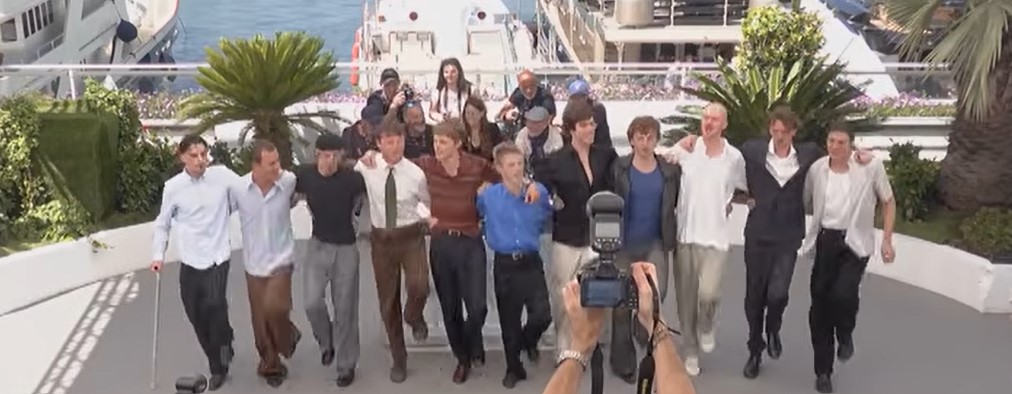
Cannes 2026 made one thing very clear: queer love stories are no longer stuck on the margins of the festival. They sit right at the centre of the films everyone is talking about, from intimate dramas to flamboyant spectacles and historical epics.
This year’s line‑up saw queer and gay narratives take up space in very different ways. Some films whispered their stories through glances and silences, others exploded in colour, music and excess, and others chose the path of tragedy and quiet heartbreak. Together, they drew a map of what it means to love outside the norm, across cultures and eras.
Read also : Cannes 2026 – Spotlight: “Teenage Sex and Death at Camp Miasma”
In La bola negra, a baroque, pop‑fuelled Spanish film by the duo known as los Javis, the directors make their intention explicit: their story carries the message that “we are not going back” when it comes to LGBTQIA+ rights. The film insists that these rights are neither decorative nor guaranteed; they are fought for, defended and re‑affirmed, including through cinema. On a global stage like Cannes, that stance feels like a direct answer to the political backlash queer communities are facing in many places.
Read also : JIM QUEEN: the queer animated comedy that turns straightness into… a virus
Different tones, same urgency
Elsewhere in the line‑up, Japanese director Koji Fukada explores a queer romance in Quelques jours à Nagi with a soft, understated approach. Desire emerges in a tightly coded social world, where simply naming what you feel already pushes against invisible walls. It is a film of modest gestures and unsaid truths, reminding us that not all queer stories are loud — some are quiet acts of resistance.
At the opposite end of the spectrum, los Javis lean fully into camp and spectacle with La bola negra: big emotions, heightened aesthetics, and an unapologetically queer lens on bodies, pleasure and punishment. Behind the glitter and excess, the film holds up a mirror to how queer people are still policed, fetishised or disciplined, and imagines joy, community and defiance as answers.
American filmmaker Ira Sachs, with The Man I Love, stays close to his trademark territory: the intimate, often painful spaces where love collides with fear, shame and social pressure. His male characters wrestle with their own limits as much as with the world around them. The result is a story where being gay is not an abstract identity, but a lived tension between wanting to be seen and needing to stay safe.
Lukas Dhont’s Coward: a gay love story in the trenches
Among the films that stood out this year, Belgian director Lukas Dhont brought a distinctly local voice to the queer landscape of Cannes with his new feature, Coward. The film unfolds on the frontlines of World War I, in the mud and terror of the trenches, where two soldiers discover a love they are not allowed to name.
By setting a gay love story in 1914–18, Dhont pays tribute to all those who loved in times and places where such feelings were considered unacceptable — or simply unthinkable. He evokes the countless queer lives erased from official history: men who served, fought, died and maybe loved each other in secret, with no trace left in letters, archives or war memorials.
Dhont’s cinema has always been drawn to tenderness in hostile environments, to young men struggling with the expectations built around masculinity and strength. With Coward, he pushes that exploration into the heart of one of Europe’s founding traumas. The film reframes the familiar imagery of the trenches — comradeship, sacrifice, fear — by showing how easily love can hide inside it, misread as simple brotherhood.
Why this matters for queer audience
Cannes will not, on its own, decide the future of LGBTQIA+ rights. But seeing multiple queer films take up space in competition and conversation does shift something. It signals that our stories are not limited to “issue films” or side plots; they can carry historical epics, love stories, political allegories and genre experiments.
For audiences in Belgium and Brussels, a film like Coward resonates even more strongly. It is a reminder that queer narratives are not only imported from elsewhere — they are also being written, directed and shaped from here, with our languages, our histories and our sensibilities. Dhont’s work continues to open up space for complex, vulnerable queer masculinity in European cinema.
And taken together, the queer films of Cannes 2026 send a simple, powerful signal that echoes the words of los Javis: whatever the backlash, whatever the attempts to roll back hard‑won progress, we are not going back. Not in life, and not on screen.
KET Magazine is a community‑driven, non‑profit magazine run by volunteers based in Brussels. Get in touch to share your thoughts or tell us about your activities. You can also promote your events on our website or support our work with a donation. Contact us at Info@ket.brussels.
You may also like
-

Endless Summer Camp: Scout Rules Meet Queer Desire at Balsamine
Summer might be over, but Sophie Guisset has other plans. From 19 to 28 November
-

Escher in Brussels: Who Said Reality Had to Behave?
Staircases refuse to play by the rules, birds become fish, and two hands draw each
-
When Nuns Go Pirate: A Queer Sacred Thriller at Varia
What happens when lesbian love, religious memory and horror theatre enter a locked convent—and refuse
-

Tels Quels Talent Show: Brussels’ Queer Voices Take the Mic
On Friday 16 October, the Tels Quels Talent Show brings live queer creativity to Les
-

CLELIA Turns Solitude Into a Shared Pop Therapy
The Brussels-based musician opens up to KET about mental health, queer visibility and her new