
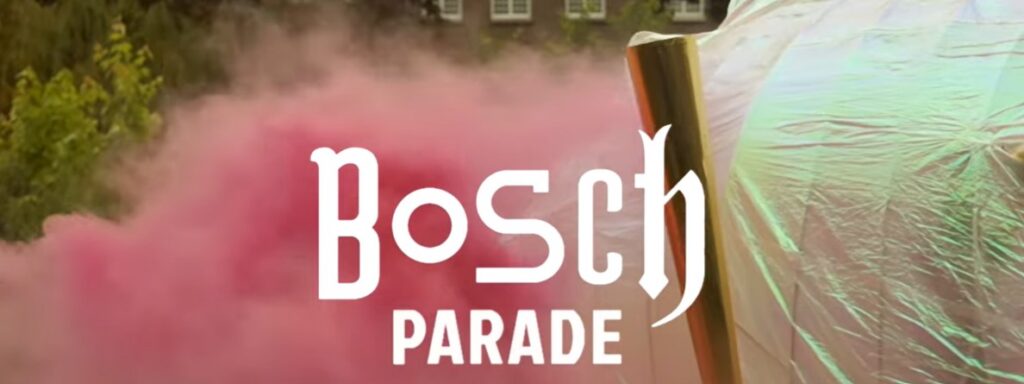
There are festivals, and then there are public artworks that feel like an entire alternate universe. Bosch Parade belongs unmistakably to the second category. Taking place in ’s-Hertogenbosch, the Netherlands, this biennial event transforms the Dommel River into a floating stage for surreal, theatrical, and often delightfully strange works of art. You can explore the event on the official website here.
What makes Bosch Parade so captivating is its dedication to movement, imagination, and absurdity. Inspired by the world of Hieronymus Bosch, the parade brings together artists, performers, and designers who create floating artworks that drift along the riverbanks in a kind of living dream sequence. The 2026 edition runs from 18 to 21 June and is themed “Powered by Defects,” a contemporary tribute to imperfection, flaw, and creative deviation.
A parade built on imagination
Bosch Parade is not a conventional festival with a fixed stage or passive audience. It is an open-air procession of works that move through water, space, and time, inviting spectators to follow the route along the river and encounter each piece as part of a larger unfolding spectacle. According to the organizers, the parade starts near Willemsbrug and continues along the Dommel toward the Garden of Earthly Delights at the Citadel, where the public can also meet artists and explore the creative process more closely.
That connection between performance and process is one of the festival’s most appealing aspects. Bosch Parade is not only about the finished artwork; it is about the energy of construction, collaboration, and the temporary city it creates around itself. In that sense, it feels very much like a queer cultural event, even if not explicitly branded as one: it celebrates transformation, hybridity, and the right to be strange in public.
Bosch for the present tense
The event’s link to Hieronymus Bosch is more than a reference to a famous name. Bosch’s art has always been associated with fantasy, moral chaos, invention, and uncanny detail, and Bosch Parade brings those qualities into the present through contemporary artists and modern concerns. The 2026 theme, Powered by Defects, turns imperfection into a source of invention rather than failure, which feels especially resonant in a culture often obsessed with polish and control.
That openness to imperfection is what gives the parade its emotional and visual force. Instead of presenting art as something pristine and distant, Bosch Parade places it in motion, in weather, in shared space, and in the unpredictable rhythm of the river. The result is a celebration that feels generous, playful, and just a little bit unruly — all qualities KET tends to appreciate.
A Dutch spectacle worth the trip
Bosch Parade also has the rare ability to feel both local and international. It is rooted in the history of ’s-Hertogenbosch, the birthplace of Bosch, but each edition brings together artists from around the world, making the event feel like a global conversation staged on water. The 2026 edition will feature nineteen new creations floating down the Dommel, attracting thousands of spectators along the riverbanks.
For visitors, the experience is as much about atmosphere as it is about the individual works. You can watch the parade from the quays, or opt for the terraces and stands at Westwal and Bolwerk if you want a more comfortable view. Either way, Bosch Parade offers a rare kind of cultural outing: part performance, part installation, part dream.
In a season crowded with festivals, Bosch Parade stands out because it refuses to choose between art and spectacle, seriousness and wonder. It is a reminder that public art can still surprise us — and that sometimes the most memorable cultural experiences are the ones that drift past us, slowly, on water.
KET Magazine is a community‑driven, non‑profit magazine run by volunteers based in Brussels. Get in touch to share your thoughts or tell us about your activities. You can also promote your events on our website or support our work with a donation. Contact us at Info@ket.brussels.
You may also like
-

Adam La Nuit: Making Music Between Worlds
For Adam La Nuit, belonging doesn’t mean choosing one world over another. The Belgian-Congolese artist
-
NAYA brings soul, soft edges and a little “Bagarre” to Café Flora
Brussels-based singer-songwriter NAYA releases her debut EP, Bagarre, on 30 October 2026, with a release
-
Tels Quels Talent Show: Brussels’ Queer Voices Take the Mic
On Friday 16 October, the Tels Quels Talent Show brings live queer creativity to Les
-

CLELIA Turns Solitude Into a Shared Pop Therapy
The Brussels-based musician opens up to KET about mental health, queer visibility and her new
-
KET in Paris — Le Hasard Ludique, Where the Tracks Lead to Music
For this stop in our KET in Paris series, we visited Le Hasard Ludique, a