
From 11 April to 16 August 2026, Mons’ CAP / Museum of Fine Arts presents Regards pluriels. Belgian art and communist utopia in the 20th century, an exhibition that traces nearly a century of Belgian artistic creation in relation to the communist movement. Structured as both a chronological and thematic journey, the show highlights the diversity of forms, commitments and tensions that shaped Belgian art throughout the 20th century.
Curated by Paul Aron, doctor in philosophy and letters, honorary research director at the FNRS and professor at ULB, the exhibition brings together works by Frans Masereel, René Magritte, Kurt Peiser, Guillaume Vanden Borre, Roger Somville, Jan Vanriet, Marthe Velle, Jo Dustin and many others [user query]. Its central idea is clear: there is no single “communist art,” but rather a plurality of approaches, sensitivities and artistic languages confronting the same political utopia.
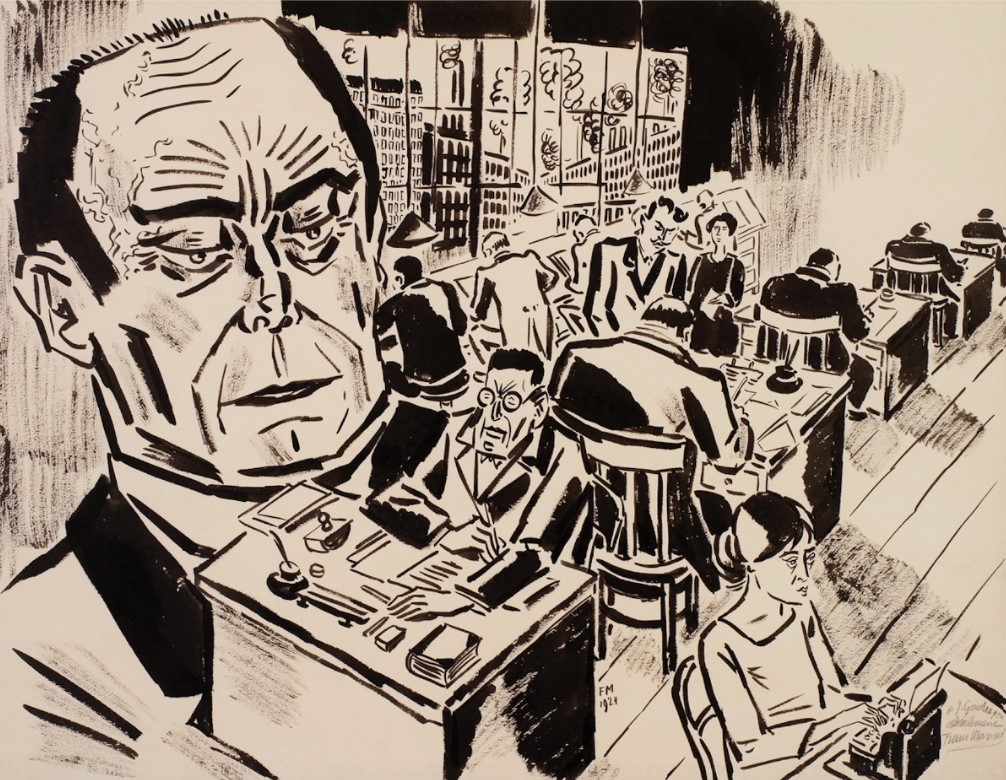
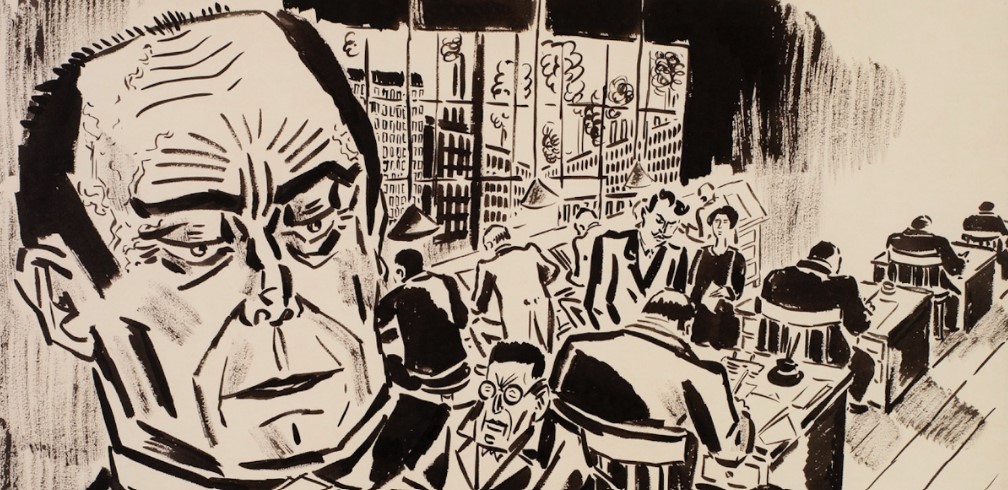
Frans Masereel, Au bureau, 1924, encre de Chine sur papier, 49,5 x 64,2 cm., photo Bernard Babette – Dries Van den Brande, © SABAM Belgium, 2026, Collection privée.
The exhibition begins with the major revolutionary symbols, with red running through the galleries as the color of social struggle and political affirmation [user query]. It also gives a major place to Frans Masereel, whose engravings and drawings, widely circulated in the progressive press, reveal an artistic practice deeply tied to anti-fascist and social struggles [user query]. More broadly, the show examines how images were used for propaganda through drawings, posters and cartoons published in communist newspapers, where art became both a tool of mobilization and a vehicle for ideas [user query].
What makes the exhibition particularly compelling is that it does not stop at overtly militant art. Realism, monumental painting, mural art and depictions of working-class life are placed in dialogue with surrealist and non-figurative practices, as well as with more intimate works shaped by irony, melancholy or dreamlike imagery [user query]. The result is a nuanced portrait of how the communist ideal inspired, challenged, divided or simply passed through very different artistic positions.
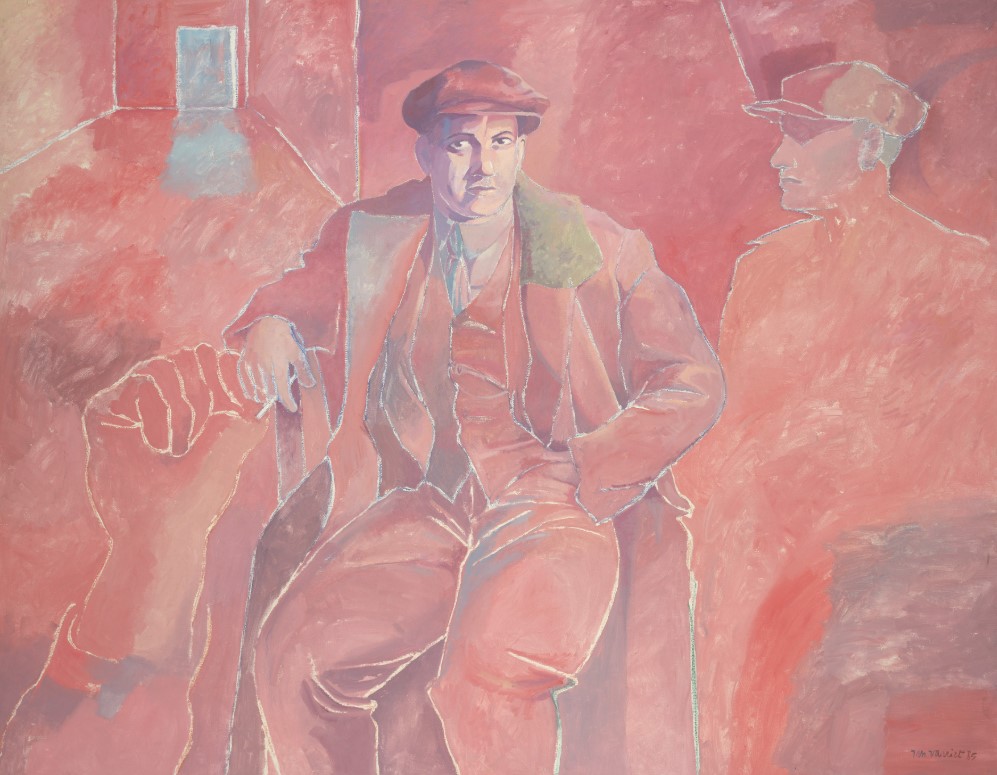
Jan Vanriet, Red Majakovski 1923, 1985, Huile sur toile, 149 x 192 cm, photo Dominique Provost, © SABAM Belgium, 2026, Collection Jan Vanriet & Semafoor
René Magritte also serves as a reminder that the relationship between Belgian avant-garde art and communism was far more complex than a simple political alignment [user query]. Some artists aimed to place art in the service of a collective ideal, while others resisted ideological frameworks — especially around abstraction and the political tensions that stretched from the major social conflicts of the 1960s to the fall of the Berlin Wall [user query]. The exhibition therefore reads Belgian 20th-century art not as a single narrative, but as a field of experiments, contradictions and shifting commitments.
Ultimately, Regards pluriels is less an exhibition about communism itself than about how Belgian artists responded to its promises, imagery and contradictions. In Mons, the CAP offers a show that connects art history and political history in a way that feels both rigorous and timely, making it a strong stop for anyone interested in Belgian creation, the avant-garde and the ties between aesthetics and engagement.
Practical information
Regards pluriels. Belgian art and communist utopia in the 20th century
11 April > 16 August 2026
Press preview: 10 April 2026 at 12:00
CAP / Museum of Fine Arts
Rue Neuve 8, 7000 Mons
Open Tuesday to Sunday, 10:00 to 18:00
Info: cap.mons.be
Tickets: +32 (0)65 33 55 80
KET Magazine is a community‑driven, non‑profit magazine run by volunteers based in Brussels. Get in touch to share your thoughts or tell us about your activities. You can also promote your events on our website or support our work with a donation. Contact us at Info@ket.brussels.
You may also like
-
Davi Pontes and Wallace Ferreira bring Repertório N.1 to Brussels
From 8 to 13 May 2026, Théâtre Les Tanneurs in Brussels will host Repertório N.1, the latest work
-
Art Brussels 2026 Reading Between the Lines, Shifting the Gaze
Spring in Brussels recalibrates bodies in space, and Art Brussels 2026 makes that shift tangible.
-
Dykes to the Front: Brussels gears up for a queer community night ahead of Dyke March
On 30 April 2026, Beursschouwburg in Brussels will host Dykes to the Front, a free community night for
-

Bongeziwe Mabandla brings South African soul to Brussels
South African singer-songwriter Bongeziwe Mabandla will perform in Brussels on 25 April 2026, with the concert taking
-
La nuit des Finta: a slam night centring FINTA and queer voices in Brussels
On 24 April 2026, Le Jacques Franck in Saint-Gilles will host La nuit des Finta, a slam event