
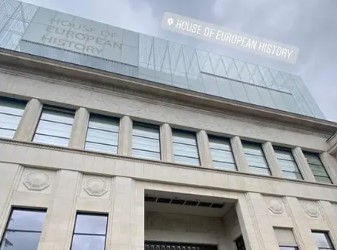
From 18 April 2026 to 14 March 2027, the House of European History in Brussels presents Postcolonial?, an exhibition that examines how Europe’s colonial history continues to shape the present. Through original artworks, historical objects and personal testimonies, the show traces the afterlives of empire and asks what “postcolonial” really means in a Europe still structured by colonial power.
The exhibition begins with the foundations of European colonialism, spanning from the 15th century to 1945, and the forms of resistance developed by colonised and enslaved peoples. It then moves into the era of decolonisation, exploring how European states retained influence even as their empires collapsed, and how independence often came without full liberation.
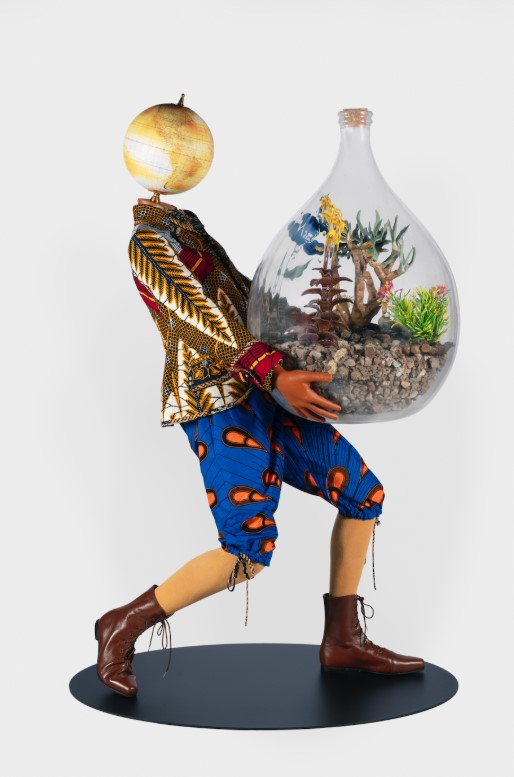
Enfant botaniste (garçon), 2024
Acquis en 2024. EU, EP, Maison de l’histoire européenne. © Yinka Shonibare CBE RA
Europe after empire
One of the exhibition’s central questions is deceptively simple: how did the colonial matrix of power survive the formal end of empire? Postcolonial? argues that colonial ideas, inequalities and injustices did not disappear with flags and borders, but continued to shape global relations, institutions and everyday life.
The second section, The end of empire?, looks at the ways Europeans maintained control while independence movements intensified and the UN Charter introduced a new human-rights framework. The third, Between independence and true freedom, turns to the hopes and limits of decolonisation, while the final section, And now?, examines how racial thinking still underpins structural inequality in education, healthcare, housing, policing and politics.
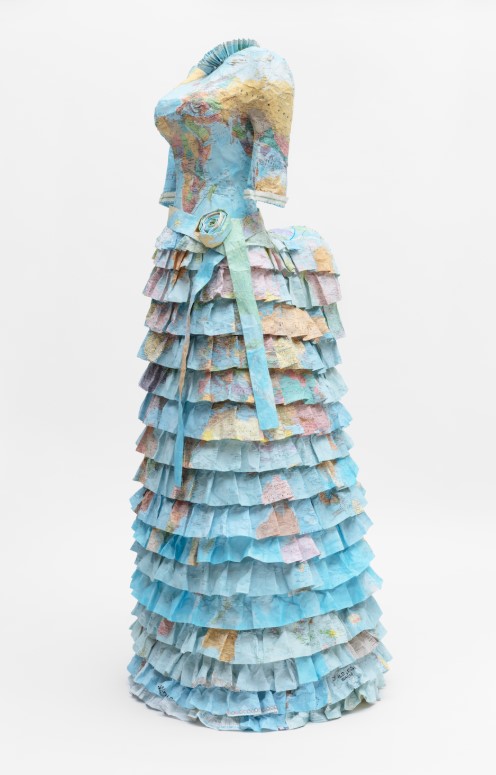
Robe coloniale, 2008
Acquis en 2019. EU, EP, Maison de l’histoire européenne. © Susan Stockwell
Personal stories and public dialogue
Alongside the historical material, the exhibition includes eight filmed personal stories that show how colonialism has shaped, and continues to shape, individual lives. That human dimension matters: it keeps the exhibition from becoming abstract and grounds the discussion in lived experience, memory and inherited struggle.
The museum is also preparing a wider programme of activities focused on dialogue, creativity and inclusive participation. Artists, academics, activists and cultural figures have been invited to co-create events that amplify decolonial voices and expand the exhibition beyond the gallery space.
Why it matters now
For a queer audience, Postcolonial? resonates beyond institutional history. Questions of race, migration, belonging, representation and structural exclusion intersect with LGBTQIA+ life in ways that are often overlooked, and this exhibition offers a useful framework for reading those overlaps more honestly.
Constanze Itzel, the museum’s director, says the exhibition is meant to correct imbalances in how Europe’s past is told, describing colonial history as part of a four-century story of violence, exploitation and global extraction. That framing places the show firmly within the current European debate over memory, responsibility and the politics of historical narration.
Practical information
Postcolonial? is on view at the House of European History, Rue Belliard 135, 1000 Brussels. The museum is open seven days a week, admission is free, and multimedia tablets are available in 24 languages; guided visits and family resources are offered in French, Dutch, German and English.
Useful links: official exhibition page, museum homepage, and Brussels Museums listing.
KET Magazine is a community‑driven, non‑profit magazine run by volunteers based in Brussels. Get in touch to share your thoughts or tell us about your activities. You can also promote your events on our website or support our work with a donation. Contact us at Info@ket.brussels.

You may also like
-
Inuit Art in Brussels: Women, Gender and Arctic Life
Women artists take a leading role in “Inuit: Impressions of the Canadian Far North” at
-

Endless Summer Camp: Scout Rules Meet Queer Desire at Balsamine
Summer might be over, but Sophie Guisset has other plans. From 19 to 28 November
-

Escher in Brussels: Who Said Reality Had to Behave?
Staircases refuse to play by the rules, birds become fish, and two hands draw each
-
When Nuns Go Pirate: A Queer Sacred Thriller at Varia
What happens when lesbian love, religious memory and horror theatre enter a locked convent—and refuse
-
KET in Paris — Le Hasard Ludique, Where the Tracks Lead to Music
For this stop in our KET in Paris series, we visited Le Hasard Ludique, a