
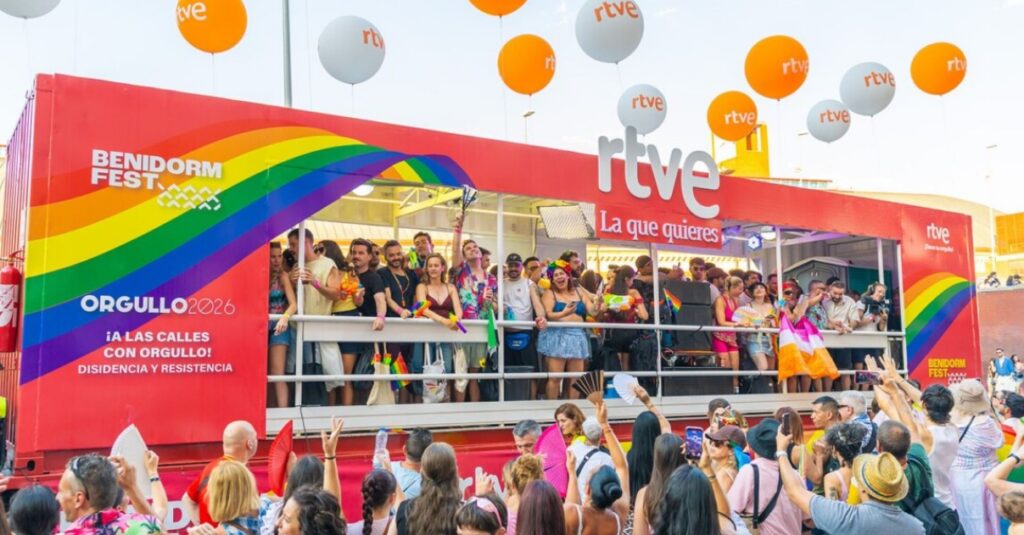
In Spain, public broadcaster RTVE once again celebrated Orgullo LGTBIQ+ by actively participating in the national Pride march in Madrid and broadcasting it live. With a dedicated show, a float in the parade and a strong editorial focus on queer stories, RTVE reaffirmed that public media can be both festive and political when it comes to defending LGBTQIA+ rights. Ket is able to share this story thanks to ELMA, the European LGBTQIA+ Media Association – a network that connects outlets like Shangay in Spain and Ket in Belgium, amplifying each other’s coverage across borders.
A Public Broadcaster That Shows Up
As Shangay reports, RTVE once again “se vuelca con la fiesta del Orgullo” – throws its full weight behind Pride – by covering the statewide LGTBIQ+ march in Madrid on La 1 and RTVE Play, and by sending its own float through the city. The special programme “Saca tu Orgullo 2026” features live commentary, interviews with activists and artists, and images from across the route between Atocha and Plaza de Colón.
This is not a one‑off gesture: it marks at least the fifth year in a row that RTVE has broadcast the march, affirming that queer visibility is part of its public service mission. In a media landscape where some broadcasters still treat Pride as a niche event, this level of engagement from a national public channel sends a strong message to viewers of all ages.
Original article (in Spanish) on Shangay:
Cameras, Floats and Queer Voices
RTVE’s coverage is not just a fixed camera on a crowd. The “Saca tu Orgullo 2026” special mobilises 17 cameras, two “cabezas calientes” (remote heads) and a drone to follow the march, as well as a float loaded with artists and staff from the broadcaster.
On the set opposite the Museo del Prado, presenters Aitor Albizua and Inés Hernand welcome guests ranging from activists like Nerea Pérez de las Heras and Elisabeth Duval to cultural figures such as Arkano, Bob Pop, Carlos Corredera and Samantha Ballantines. This mix ensures that the broadcast centres queer and allied voices, rather than reducing the march to a colourful backdrop.
The special also features music linked to Benidorm Fest 2026, with the song “Sé quién eres” serving as a kind of Pride anthem. By tying pop culture, activism and news together, RTVE offers a holistic Pride experience that goes beyond simple spectacle.
Pride as a Political Statement
The Madrid Pride march has long been both a celebration and a protest. Recent editions have carried slogans like “20 años avanzando en derechos: ni un paso atrás” (“20 years advancing in rights: not one step back”), marking the anniversary of marriage equality in Spain and warning against attempts to roll back gains.
RTVE’s decision to broadcast and participate with a float is therefore not neutral. It positions the broadcaster clearly in support of LGTBIQ+ rights, at a time when parts of Europe – including Hungary, Poland and even some Spanish regions – are seeing renewed attacks on gender and sexual minorities. For queer viewers in Belgium and beyond, this offers an example of how public media can stand on the side of equality, rather than hiding behind “false balance”.
ELMA: Making Pride Stories Travel
Ket can bring you this story thanks to ELMA (European LGBTQIA+ Media Association), a network that includes Shangay (Spain), Humen Online (Hungary), Ket (Belgium) and several other queer outlets across Europe. ELMA’s goal is to share resources, cross‑publish key articles and strengthen the impact of LGBTQ+ media on a continental scale.
When Shangay covers RTVE’s role in Madrid Pride, that reporting can travel to Brussels through Ket. When Ket reports on Brussels Pride, queer festivals, or legal changes affecting LGBTQIA+ people in Belgium, those stories can circulate in Spanish, Hungarian or other languages via partner media. In a time of transnational backlash, this kind of shared information infrastructure is crucial: it helps communities learn from each other’s wins and strategies.
Why This Matters for Brussels
For readers in Brussels, RTVE’s Pride coverage raises useful questions about our own media landscape. How do RTBF, VRT or BX1 cover Pride and queer issues? Do they send cameras, floats, dedicated programmes – or do they still treat our struggles as marginal? Stories like this one from Spain can serve as a benchmark and an inspiration, especially when queer communities here push for more inclusive, committed coverage.
Through ELMA, Ket will keep sharing examples of how public and private media across Europe engage with LGBTQIA+ lives – whether through Pride broadcasts, documentary seasons, queer series or investigative reporting on anti‑LGBTQ+ laws. The more we see, the more we can demand.
Useful Links
- Original article (ES): RTVE vuelve a celebrar el Orgullo LGTBIQ+ en la manifestación estatal de Madrid.
- RTVE Pride coverage:
- Overview of the 2026 broadcast and float: TVE se vuelca con la fiesta del Orgullo.elperiodico
- Video summary and full march via RTVE: rtve.es – Orgullo LGTBIQ+.
- ELMA (European LGBTQIA+ Media Association): elma.lgbt.
Seeing a public broadcaster march, sing and broadcast alongside the community doesn’t fix everything – but it does show what institutional allyship can look like in practice. And thanks to networks like ELMA, these images don’t stay in Madrid’s streets; they ripple outwards, reaching queer viewers and readers far beyond Spain.
Journalist : Miguel San Martín
KET Magazine is a community‑driven, non‑profit magazine run by volunteers and based in Brussels. You can find our other music and nightlife stories on ket.brussels, and you can always write to us to share your projects or pitch a story: info@ket.brussels
You may also like
-

In Myanmar, the Spirit Wives Keep Dancing
Near Mandalay, in a country torn apart by civil war, the annual Taungbyone festival has
-

Five Equality Champions Remind WorldPride What Queer Progress Looks Like
On 5 August, during the WorldPride Human Rights Conference in Amsterdam, UNDP and ILGA World
-

Lenacapavir: Hope, Hype and a Price Tag That Hurts
Lenacapavir is the name on everyone’s lips at the World AIDS Conference in Rio de
-
Milan Violon and the Fight for Queer Visibility in Sport
At just 17, Milan Violon has become the first man to represent France in artistic
-
Berlin Pride Attack: Our Solidarity Is With the Victims, Their Loved Ones and the LGBTQIA+ Community
A vehicle drove into the crowd at Berlin Pride on Saturday, killing at least one