

Why does finding a home in Brussels feel so complicated? Who does the work that never appears on a payslip? Bruscope, an independent, participatory Brussels media initiative, takes these everyday questions seriously, making socio-economic research easier to understand and bringing possible solutions into view. For LGBTQIA+ readers, its appeal is practical: a more inclusive city also means talking about housing, work and the conditions that allow us to build a life here.
A closer look at the city we actually live in
Brussels is more than its cultural calendar. It is also the rent payment, the job search and the time spent keeping a household running. These are the kinds of subjects Bruscope puts under the microscope.
Its name comes with a fitting tagline: “Bruxelles à la loupe” — Brussels under the magnifying glass. The project describes itself as a platform for making complex local issues accessible, with housing, employment, mobility, the environment and food among its areas of interest. Its guiding principle is equally direct: understand in order to act.
Rather than stopping at a diagnosis, Bruscope wants to explain causes and circulate credible responses. Its stated ambition is to connect research with a wider public, bringing experts’ recommendations beyond academic circles and into conversations about how the city could work differently.
Housing: getting beyond “that’s just Brussels”
The first issue tackles a question likely to feel familiar to many readers: how can Brussels reduce the growing gap between housing prices and residents’ incomes? It examines the financialisation of housing — the increasing role of property as a financial asset — and explores possible responses. The issue is available to read freely online, with a printed edition also on sale.
In an interview with Mammouth, Bruscope’s Naomé Ide explained that housing was an obvious starting point because of the pressure rent places on household budgets. She also described her approach as one of extensive documentation and engagement with research, rather than claiming personal expertise in every subject the publication covers.
That distinction matters. The promise is not a quick fix for your next apartment search, but a way to understand the forces behind an individual experience — and why changing those conditions requires more than better budgeting.
Who gets paid, and who keeps everything running?
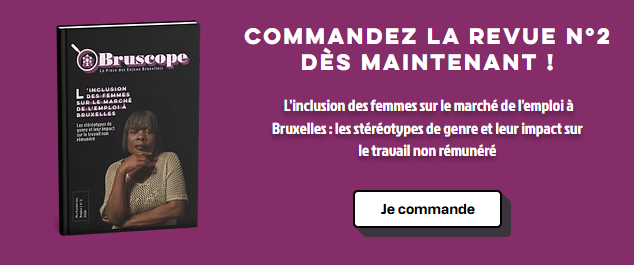
Bruscope’s second issue turns to women’s inclusion in the Brussels labour market, focusing on gender stereotypes and their impact on unpaid work. It follows a three-part structure: diagnosis, causes and recommendations.
The subject shifts attention towards work that can disappear from conventional conversations about employment: the unpaid labour that makes everyday life possible. By examining it alongside access to paid work, the issue invites readers to consider the relationship between what happens at home and what becomes possible professionally.
There is a visual dimension, too. Illustrator Chloé Thomé created a series of felt-tip portraits of around twenty women for the publication, bringing human faces into a subject often discussed through abstract categories.
Why this belongs in a queer conversation
Bruscope does not present itself as an LGBTQIA+-specific outlet. Its published mission is broader: making knowledge about Brussels’ social and economic challenges more accessible.
For queer readers, the connection is belonging. Being able to build a life in Brussels involves more than finding representation on a stage or a screen; it also means having somewhere to live, room to work and time for relationships and community.
That is an editorial lens, not a claim that Bruscope’s publications provide dedicated analysis of every LGBTQIA+ experience. A focus on women’s employment, for example, should not automatically be read as a specific account of trans or non-binary people’s circumstances.
What the project offers is a useful starting point for making connections: between gender expectations and economic independence, between housing policy and everyday security, and between individual difficulties and collective choices.
Research without the closed door
Bruscope’s ambition extends beyond its printed issues. Its presentation outlines a mix of explanatory videos, illustrated thematic publications, podcasts featuring Brussels voices and conferences. The website also announces BRUSTALK as another strand of the project.
The important point is not simply the number of formats. It is the intention behind them: giving people different ways into subjects that can otherwise feel technical or remote.
That solutions-led approach is welcome, provided “solutions” remain open to scrutiny rather than becoming another reassuring slogan. Bruscope’s emphasis on research offers readers a basis for asking the useful next questions: what is being proposed, who would benefit, and what would it take to make it happen?
Practical information
- What: Bruscope, a Brussels-based independent, participatory media initiative focused on socio-economic issues and possible solutions.
- Read online: The first housing issue is available in open access through the Bruscope website.bruscope
- Print publications: The shop lists the housing issue and the issue on women’s work at €15 each. Check delivery conditions when ordering.
- Browse and order: Visit the publication shop.
- Learn about the project: Read Bruscope’s mission and approach.bruscope
- Follow or support: The website provides newsletter registration and a link to support the initiative through Tipeee.
- Contact: info@bruscope.be.
Sometimes seeing Brussels differently starts with understanding something you have been dealing with for years. Bruscope offers a place to pause, look closer and find a little more substance for the next conversation.
KET Magazine is a community‑driven, non‑profit magazine run by volunteers based in Brussels. Get in touch to share your thoughts or tell us about your activities. You can also promote your events on our website or support our work with a donation. Contact us at Info@ket.brussels.
You may also like
-

At Liège’s Queer Families Festival, Every Family Has a Story
The third edition of the Queer Families Festival takes place on 11 October at the
-

“After”: Listening to LGBTQIA+ Survivors Speak About Intimate Partner Violence
On 8 October, Tels Quels invites people to Les Grands Carmes in central Brussels for
-
Liège’s Maison Arc-en-Ciel Needs Support to Keep Its Doors Open
Maison Arc-en-Ciel de Liège, a vital LGBTQIA+ community hub in Wallonia, is facing growing financial
-
Garden Party de la Maison Arc-en-Ciel de Liège
Liège’s Maison Arc-en-Ciel is bringing back its annual Garden Party on Saturday 5 September 2026.
-
IGLYO Wants to Hear From You: Europe’s Biggest LGBTQI School Survey Is Back
IGLYO, the Brussels-based international LGBTQI youth network, has just launched the second edition of its